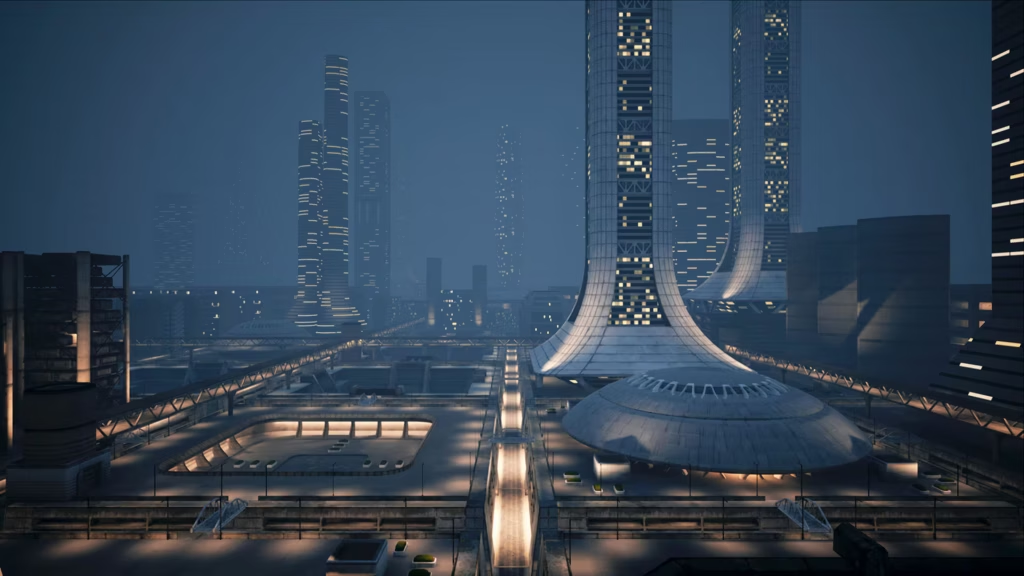
On September 16, 2025, the Saudi sovereign wealth fund PIF suspended construction work on The Line until further notice. The Financial Times reported that architects were already working on redesigning the project into something “more modest” that could use existing infrastructure in a completely different way. In January 2026, Saudi Arabia indefinitely postponed the Asian Winter Games that had been scheduled for 2029 at Trojena, another NEOM sub-project. International media began describing The Line as a “likely failure.”
The original vision, announced in 2021 by Crown Prince Mohammed bin Salman, was staggering: a 170-kilometer linear city of mirrored glass, 500 meters tall and 200 meters wide, housing 9 million people with zero cars, zero carbon emissions, and everything within a five-minute walk. The estimated cost started at $500 billion. Internal estimates later grew to $4.5 trillion, then to $8.8 trillion and counting.
Five years and at least $50 billion later, only a 2.4-kilometer stretch of foundation work exists. No residents have moved in. The timeline for full completion has been pushed from 2030 to 2045, and the population target for the end of this decade has been reduced from 1.5 million to fewer than 300,000.
What happened to the most expensive construction project in history is a case study in what occurs when engineering ambition collides with physics, finance, and political reality.
—
What Was Actually Built
The construction that took place between 2022 and 2025 was primarily earthworks, excavation, and deep foundation work. Crews drilled approximately 6,000 piles into the desert, some 2.5 to 3 meters in diameter — among the largest foundation piles ever constructed. Sixty piling rigs worked around the clock across a 2-kilometer stretch. This foundation work alone cost several billion dollars.
Satellite imagery from late 2024 confirmed large-scale earthworks, completed buildings (primarily worker housing and support facilities), and grid-like infrastructure layouts. A canal system for the “Hidden Marina” section — a mixed-use leisure area with hotels — had been excavated. But the vertical construction that would define The Line as a building — the twin mirrored walls rising 500 meters — had not begun in any visible form.
The fundamental challenge was not the ability to build tall structures (Saudi Arabia already has some of the world’s tallest buildings) but the scale of doing so continuously across 170 kilometers of desert terrain. The concrete supply chain alone required a dedicated $186 million factory capable of producing 20,000 cubic meters per day, fed by a desalination plant at the Oxagon coastal facility. As of mid-2025, that factory infrastructure did not yet exist, and concrete was being produced locally with water shipped in by tanker — a process that construction specialists described as fundamentally unscalable.
—
Why It Stalled
Three forces converged to stall The Line.
The first was financial pressure. The project is funded by PIF, Saudi Arabia’s sovereign wealth fund, which manages nearly $1 trillion in assets. The fund recorded an $8 billion write-down in 2025 linked to NEOM and other megaprojects. Oil prices — which ultimately fund the PIF — declined through 2024 and 2025, reducing available capital at the same time that cost estimates ballooned. The expected foreign investment that was supposed to supplement Saudi capital largely failed to materialize.
The second was technical reality. A Wall Street Journal investigation in 2025 uncovered an internal audit finding “evidence of deliberate manipulation” by project managers. Multiple construction executives told the Financial Times that they privately considered the full 170-kilometer project impossible. The engineering challenges — from desert heat effects on concrete curing to the logistics of building two 500-meter walls across mountain terrain — were known from the beginning but had been publicly minimized.
The third was strategic reprioritization. Saudi Arabia is simultaneously preparing to host the 2034 FIFA World Cup, which requires stadium and infrastructure construction across the country. With limited construction capacity and competing priorities, the government chose to focus resources on projects with firm international deadlines over a megacity with a self-imposed timeline.
—
The Redesign
The current direction, according to Financial Times reporting from January 2026, is a fundamental reconceptualization. The Line will not be abandoned — the foundation work and infrastructure already built represent too large an investment to walk away from. Instead, it will become “a totally different concept” that uses existing infrastructure “in a totally different manner.”
NEOM leadership has reportedly shifted emphasis toward industrial applications, including positioning the site as a hub for data centers — a sector with enormous global demand and less dependence on the residential megacity concept. The phased approach now prioritizes a 2-5 kilometer section for structural completion by late 2026, functioning as a pilot neighborhood with residential and commercial space.
A consortium including Delugan Meissl Associate Architects, Gensler, and Mott MacDonald was appointed to lead redesign work, focusing on individual neighborhoods rather than a continuous 170-kilometer structure. The approach has shifted from “build the entire vision at once” to “build functional sections that demonstrate the concept.”
—
What The Line Tells Us
The Line is not simply a failed construction project. It is a test case for the limits of state-directed megaproject ambition — and the results are instructive.
The engineering was never the primary obstacle. Tall buildings, high-speed rail, mirrored glass facades, renewable energy systems — all of these technologies exist and work. The failure was one of integration and scale: attempting to combine every ambitious technology simultaneously, at a scale never previously attempted, on a timeline driven by political desire rather than engineering capacity.
The comparison to historical megaprojects is revealing. The Burj Khalifa — the world’s tallest building — took 6 years to construct and cost $1.5 billion. The original cost for the much more modest 2.4-kilometer pilot section of The Line has already exceeded that by multiples. The leap from building the world’s tallest tower to building a 170-kilometer linear city is not a factor of 10 in complexity — it is a factor of thousands.
Whether The Line eventually becomes a functional city, a scaled-back technology district, or an expensive monument to overreach will be determined in the next 3-5 years. The construction crews, the foundation piles, and the desert excavations are real. The question is what, if anything, will rise above them.
—
Sources:
1. Wikipedia — The Line, Saudi Arabia (updated January 2026) 2. Euronews — Saudi Arabia Reduces Ambitious Plans for The Line (January 2026) 3. Newsweek — How Saudi Arabia’s Futuristic Megacity Will Progress in 2026 (January 2026) 4. The Real Deal — NEOM’s The Line Project Stalled in Saudi Arabia (November 2025) 5. The B1M — Can Saudi Arabia Still Complete The Line? (2025) 6. RP RealtyPlus — Saudi’s NEOM Project Scales Back But Construction Continues (October 2025) 7. Hotel Designs — Is This the End of The Line for Saudi Arabia’s Wall City? (January 2026)
Disclaimer: This article discusses construction and urban development projects for informational purposes. It does not constitute investment or real estate advice.