The Supreme Court Killed Trump’s Tariffs on Friday. By Saturday, He Had Already Found a Way Around the Ruling.
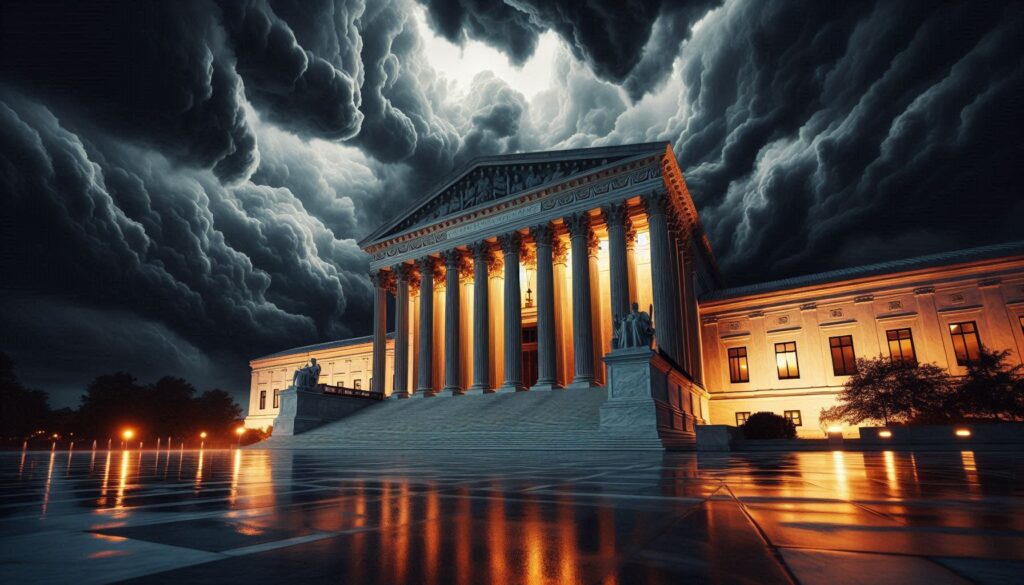
It took Chief Justice John Roberts fewer than thirty pages to dismantle the legal architecture of the most aggressive tariff regime in a century. The opinion, delivered at 10 a.m. on a Friday morning to a courtroom packed with trade lawyers and White House officials, opened with a sentence that left no room for ambiguity: “We decide whether the International Emergency Economic Powers Act authorizes the President to impose tariffs.”
The answer was no.
By noon, the S&P 500 had jumped 0.7%. By early afternoon, President Trump was standing behind a podium in the Brady Press Briefing Room calling the justices who ruled against him — including two he personally nominated — “unpatriotic and disloyal to our Constitution.” By evening, he had signed an executive order imposing a brand new 10% global tariff under a different statute entirely. And by Saturday morning, he raised it to 15%.
The most consequential trade ruling in modern American history lasted less than twelve hours before the president tried to replace it with something else.
What the Court Actually Said
The February 20 decision in Learning Resources, Inc. v. Trump was not close. Six justices — Roberts, Sotomayor, Kagan, Gorsuch, Barrett, and Jackson — formed the majority. Only Thomas, Alito, and Kavanaugh dissented.
The core holding was straightforward. The International Emergency Economic Powers Act of 1977 grants the president authority to “regulate importation” during national emergencies. Trump’s administration had interpreted that phrase as permission to impose tariffs of unlimited amount, duration, and scope on virtually every country on earth. Roberts wrote that IEEPA contains no reference to tariffs or duties, and that no president in the law’s nearly five-decade history had ever read it to authorize taxation.
The ruling did not touch tariffs imposed under other statutes. Duties on steel, aluminum, automobiles, copper, and semiconductors — all enacted under Section 232 of the Trade Expansion Act — remain in force. So do the Section 301 tariffs on Chinese goods that predate this administration. What fell were the sweeping “reciprocal” tariffs Trump announced on Liberation Day in April 2025, the fentanyl-related duties on China, Canada, and Mexico, and the country-specific rates negotiated in dozens of bilateral deals over the past year.
In practical terms, the ruling wiped out roughly 60% of all tariff revenue the federal government had been collecting.
The $175 Billion Question
The money is where things get complicated — and potentially chaotic.
Since Trump began imposing IEEPA tariffs in February 2025, U.S. Customs and Border Protection has collected approximately $142 billion under that authority through the end of 2025 alone. Penn Wharton Budget Model estimates put the total exposure, including collections through January 2026, at up to $175 billion. By one estimate, the government was collecting roughly $500 million per day in IEEPA duties before the ruling.
The Supreme Court declared those collections unlawful. It did not, however, order refunds.
That silence was deliberate — and it is already creating a legal scramble. Justice Kavanaugh, writing in dissent, warned that the refund process was likely to be a “mess.” Trade attorneys are more specific: importers generally have 180 days after goods are liquidated to protest and request refunds from CBP. Given that goods were liquidated throughout 2025 and into 2026, the refund timeline stretches deep into 2027.
Major corporations are not waiting. Costco, Toyota, and Barnes & Noble have already filed lawsuits seeking to recover their tariff payments. Illinois Governor J.B. Pritzker sent a letter to the White House demanding $8.7 billion on behalf of his state’s 5.11 million households, claiming each family bore $1,700 in tariff costs. Nevada’s treasurer submitted a formal payment request for $2.1 billion.
The Cato Institute’s Scott Lincicome argued in the Wall Street Journal that refunds could be remarkably simple — nearly all duty payments are electronic and could be returned at the push of a button. But the more likely outcome, he conceded, is that the administration will make the process as burdensome as possible, forcing importers to file mountains of paperwork or sue individually.
The administration itself has sent mixed signals. Trump suggested at his press conference that a court fight over refunds could take years. Treasury Secretary Scott Bessent said nothing about timelines but promised that replacement tariffs would keep revenue “virtually unchanged.”
The Section 122 Gambit
Trump’s response to the ruling came with remarkable speed and dubious legal footing.
Within hours of the decision, he signed a proclamation invoking Section 122 of the Trade Act of 1974 — a provision that had never been used by any president in the statute’s half-century existence. Section 122 allows a “temporary import surcharge” of up to 15% to address “fundamental international payment problems.” On Friday evening, Trump set the rate at 10%. By Saturday, he bumped it to the legal maximum of 15%.
The provision expires automatically after 150 days unless Congress votes to extend it. That clock runs out on July 24, 2026.
Trade economists immediately raised questions about the legal basis. Section 122 was designed for a fixed-exchange-rate world — it was enacted after Richard Nixon’s 1971 emergency import surcharge and is predicated on “large and serious” balance-of-payments deficits that threaten significant depreciation of the dollar. The United States adopted a floating exchange rate system in the early 1970s, which eliminated the specific mechanism Section 122 was built to address.
“Section 122 was effectively rendered obsolete,” wrote Colin Riley, a trade policy fellow, in an analysis published by Fortune. The statute authorizes tariffs only in the presence of a fundamental international payments problem. Because the United States does not face such a problem under the floating-rate system, Riley argued, Section 122 cannot legally be used for this purpose.
New legal challenges seem inevitable. JPMorgan analysts wrote Friday night that “trade uncertainty in the coming months will remain elevated” and predicted the average tariff rate would settle around 9-10%, with most eventual duties shifting to Sections 301 and 232.
The Economy the Ruling Landed In
The Supreme Court decision arrived on the same morning the Commerce Department released fourth-quarter GDP data — and both pieces of news told the same story about an economy running on fumes and contradictions.
GDP grew at just 1.4% annualized in Q4 2025, a sharp deceleration from the 4.4% pace in the third quarter and well below the consensus forecast of 2.5-3.0%. The longest government shutdown in American history — 43 days, from October 1 through mid-November — subtracted roughly a full percentage point from growth. But even stripping out that drag, the underlying picture was soft. Consumer spending slowed to 2.4%, down from 3.5%, and goods purchases actually declined.
For the full year, the U.S. economy grew 2.2%, the slowest pace since 2020. The expansion was notably jobless — employers added only 181,000 positions across all of 2025, compared to more than 1.4 million the year before.
Meanwhile, the Federal Reserve’s preferred inflation gauge — core PCE — rose to 3.0% year-over-year in December, the highest reading in nearly a year. Monthly core PCE jumped 0.4%, exceeding expectations and complicating any path toward rate cuts. The combination of 1.4% growth and 3% core inflation amounts to a textbook stagflation scenario: the economy is slowing while prices keep climbing.
EY-Parthenon chief economist Gregory Daco warned that “strong aggregate GDP growth may be masking underlying fragilities” and that the expansion rests on a narrow foundation of affluent consumers, AI-driven investment, and asset price appreciation — what he called the “three A’s” that could break down if any one pillar falters.
The Trade Deficit That Tariffs Didn’t Fix
Perhaps the most damning data point for the administration’s trade agenda arrived two days before the Supreme Court ruling.
The Commerce Department reported that the U.S. ran a $901.5 billion trade deficit in 2025, essentially unchanged from the year before. After twelve months of the most aggressive tariff regime since the 1930s, the deficit moved by $2.1 billion — a rounding error on a $4.3 trillion import bill.
The goods trade deficit in manufactured products actually grew by $62 billion, or 3.9%, compared to 2024. And the manufacturing sector bled 88,000 jobs during Trump’s first eleven months back in office — the opposite of the “roaring” return of factories he promised on Liberation Day.
What happened instead was a geographic shell game. JPMorgan data showed that payments from midsize U.S. firms to China fell by roughly 20% since 2024, consistent with the goal of reducing Chinese dependence. But companies did not bring production home. They shifted orders to Southeast Asia, India, and Japan — paying a historic premium for the privilege. China’s tariffs dropped from 36% to roughly 21% under the Section 122 replacement, and imports from ASEAN countries, Mexico, and Taiwan all increased.
A Deloitte analysis quantified the structural obstacles to reshoring. U.S. manufacturing labor costs average $25-30 per hour, compared to $6-7 in China. Nearly 500,000 manufacturing positions remain unfilled because modern factories demand digital, robotics, and AI skills that the current workforce cannot supply. By 2033, the industry may need 3.8 million new workers, with almost half those roles at risk of going unfilled.
In a survey of over 500 manufacturers, 30% said they would reshore production if a skilled workforce were available. That condition is not close to being met.
What the World Heard
The ruling sent shockwaves far beyond Washington.
German Chancellor Friedrich Merz told ARD that he expected the tariff burden on his country’s economy to fall and flagged an upcoming visit to Washington to present a coordinated European position. European Parliament trade committee chairman Bernd Lange was more direct, insisting on Deutschlandradio that excess tariffs “must be refunded” and estimating that German companies alone had overpaid more than €100 billion ($118 billion).
South Korea’s Trade Ministry called an emergency meeting. Indonesia’s chief trade negotiator confirmed that his country’s bilateral deal — signed the same day as the ruling — remains in force despite the legal upheaval. Switzerland’s technology industry association hailed the decision but cautioned that nothing had been won yet, noting exports to the U.S. fell 18% in the fourth quarter under the old regime.
For China, the math shifted dramatically. Under the IEEPA framework, Chinese goods faced roughly 36% in combined tariffs. The Section 122 replacement drops the universal rate to 15%, and with existing Section 232 duties factored in, the total effective rate on Chinese imports falls to approximately 35% — still high, but a meaningful reduction. Beijing’s embassy in Washington issued a statement noting that trade wars benefit nobody and that the ruling was broadly welcomed.
Countries like Brazil, which never negotiated a bilateral tariff reduction and had been paying 40%, could see their rates drop to 15% — at least temporarily.
150 Days and Counting
The global economy now enters one of its most legally and economically uncertain periods since the pandemic.
The Section 122 tariffs expire on July 24 unless Congress acts. Trump’s trade representative has launched new Section 301 investigations that could produce replacement tariffs — but those require at minimum two to three months of investigation before any duties can be imposed. The Section 232 process demands a Commerce Department investigation, public hearings, and a formal determination.
Yale’s Budget Lab estimates that the post-SCOTUS effective tariff rate dropped from a pre-substitution 16.9% to 6.7%, and that consumer prices will now rise 0.6% instead of the 1.4% that would have applied under the full IEEPA regime. The remaining tariffs will still shrink the U.S. economy by 0.1% in the long run — about $30 billion annually — and push unemployment 0.3 percentage points higher by year-end. But the refund impulse from returned IEEPA duties could roughly offset the drag in 2026, creating an unusual and temporary fiscal stimulus.
For businesses, the uncertainty calculus has shifted rather than resolved. Companies that spent 2025 restructuring supply chains, front-loading imports, rewriting contracts, and delaying capital expenditure are now facing a new set of questions. Do the bilateral trade deals hold? Will refunds actually arrive? Does it make sense to unwind the supply chain changes made under the old regime, knowing that new tariffs could snap back within months?
The Morningstar assessment may have captured the mood best: the ruling boosted clarity in the short term, but “anything that can eliminate or reduce this uncertainty will be viewed as positive by those impacted.” The emphasis was on can. What nobody knows yet is whether this ruling eliminates uncertainty — or simply replaces one form of it with another.
The Constitution assigns the power to levy tariffs to Congress. The Supreme Court has now said so explicitly. Whether that principle survives a president who has described himself as the “tariff man” and shown no inclination to accept the limitation may be the defining economic question of 2026.
SOURCES
- Tax Foundation — Trump Tariffs: The Economic Impact of the Trump Trade War (February 2026): https://taxfoundation.org/research/all/federal/trump-tariffs-trade-war/
- SCOTUSblog — A Breakdown of the Court’s Tariff Decision (February 20, 2026): https://www.scotusblog.com/2026/02/a-breakdown-of-the-courts-tariff-decision/
- Penn Wharton Budget Model — Supreme Court Tariff Ruling: IEEPA Revenue and Potential Refunds (February 20, 2026): https://budgetmodel.wharton.upenn.edu/issues/2026/2/20/supreme-court-tariff-ruling-ieepa-revenue-and-potential-refunds
- CNBC — Trump Announces 10% Global Tariff After Supreme Court Loss (February 20, 2026): https://www.cnbc.com/2026/02/20/trump-global-trade-tariff-supreme-court.html
- Yale Budget Lab — State of U.S. Tariffs: SCOTUS Ruling Update (February 20, 2026): https://budgetlab.yale.edu/research/state-us-tariffs-february-20-2026
- U.S. Bureau of Economic Analysis — GDP Advance Estimate Q4 2025 (February 20, 2026): https://www.bea.gov/news/2026/gdp-advance-estimate-4th-quarter-and-year-2025
- Rethink Trade — Did Trump’s Manufacturing Promises Work? (February 2026): https://rethinktrade.org/trumptrademanufacturing/