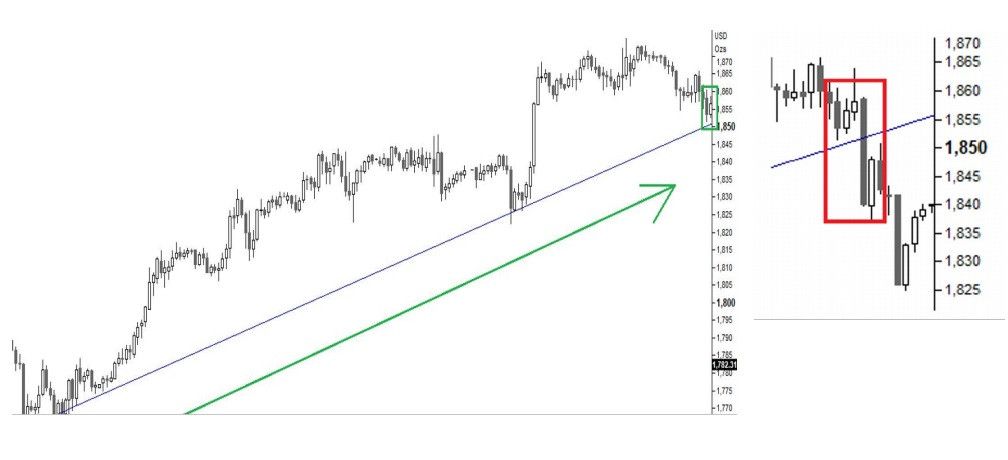
Studies consistently show that roughly 90% of retail traders lose money. They do not lose because they use the wrong candlestick patterns. They lose because they trade patterns in isolation — without the structural context that distinguishes a high-probability setup from a coin flip.
Professional traders — institutional desk operators, hedge fund portfolio managers, proprietary firm traders — do not memorize candlestick encyclopedias. They operate on a framework that integrates three elements: market structure (the terrain), key levels (the battleground), and candlestick patterns (the confirmation). The pattern is always the last element in the decision chain, never the first.
This article explains the framework that underpins high-probability price action trading, based on how institutional market participants actually use candlestick analysis.
—
The Core Problem: Patterns Without Context
Open any trading education resource and you will find a catalog of candlestick patterns — Hammers, Engulfings, Dojis, Morning Stars — each accompanied by textbook examples showing the pattern followed by a perfectly predictable price movement.
What these resources omit is that any of these patterns can appear at any point on any chart. A Hammer at a major institutional support level has a fundamentally different probability profile than a Hammer in the middle of a range with no historical significance. The pattern is visually identical. The expected outcome is not.
This distinction is what professional traders call “confluence” — the alignment of multiple independent indicators pointing to the same conclusion. A Hammer at a key support level with increasing volume and alignment with a higher timeframe trend has confluence. A Hammer without any of those factors is a random event with near-random outcomes.
—
Step 1: Identify Market Structure First
Before examining a single candlestick, professional traders determine the prevailing market structure. Is the market trending (making higher highs and higher lows in an uptrend, or lower highs and lower lows in a downtrend)? Or is it ranging (oscillating between defined support and resistance boundaries)?
This matters because the optimal strategy differs fundamentally. In trending markets, the highest-probability approach is to wait for pullbacks (retracements against the trend) and enter in the direction of the dominant trend when the pullback shows signs of exhaustion. In ranging markets, the strategy shifts to buying at support and selling at resistance.
Attempting to trade bullish reversal patterns in a strong downtrend — or bearish patterns in a strong uptrend — is fighting the prevailing order flow. Institutional capital drives trends, and retail traders who position against institutional flow are systematically disadvantaged.
The higher timeframe sets the structural context. A daily chart in a clear uptrend should bias all analysis toward long entries, even if a 15-minute chart shows temporary bearish patterns.
—
Step 2: Mark Key Institutional Levels
Once market structure is identified, the next step is identifying the specific price levels where institutional participants are most likely to act. These are the “battlegrounds” where supply and demand concentrate.
Previous swing highs and lows. Prices where the market previously reversed represent levels where significant buying or selling orders accumulated. These levels tend to attract activity again when price returns to them.
High-volume nodes. Using volume profile analysis, traders identify price levels where the most trading volume occurred historically. These levels represent areas of institutional agreement — prices where large participants considered fair value and transacted heavily.
Round numbers and psychological levels. Markets routinely react to major round numbers ($100, $50,000 for Bitcoin, 4,000 for the S&P 500). These levels function as anchors because human decision-making clusters around round figures, and automated trading systems often place orders at these levels.
Moving averages. The 50-day and 200-day simple moving averages are among the most widely watched indicators in institutional trading. When price approaches these levels, the concentration of order flow around them creates self-reinforcing reactions.
The discipline is to mark these levels before the market opens and wait for price to arrive at them. This eliminates the reactive impulse trading that destroys most retail accounts.
—
Step 3: Wait for Candlestick Confirmation at Key Levels
Only after identifying structure and marking levels does the candlestick pattern enter the analysis. The pattern’s role is strictly confirmatory — it provides evidence that the pre-identified level is producing the expected buyer or seller response.
At support in an uptrend: Look for bullish reversal patterns (Hammer, Bullish Engulfing, Morning Star) that show buyers defending the level. The pattern confirms that the support is holding and the uptrend is likely to continue.
At resistance in a downtrend: Look for bearish reversal patterns (Shooting Star, Bearish Engulfing, Evening Star) that show sellers defending the level. The pattern confirms that resistance is holding and the downtrend is likely to continue.
At range boundaries: Look for rejection patterns at either end of the range — bullish patterns at the bottom, bearish patterns at the top — confirming that the range continues to contain price.
The critical discipline is patience. Waiting for price to reach a key level, then waiting for a confirming candlestick pattern on the relevant timeframe, eliminates the majority of low-probability trades that erode accounts through death by a thousand cuts.
—
Step 4: Verify with Volume
A candlestick pattern at a key level with supporting volume is the highest-probability setup available in price action trading. Volume confirms that the pattern is driven by genuine order flow rather than thin-market noise.
Specifically, look for above-average volume on the confirming candle itself. A Bullish Engulfing at support with three times normal volume indicates that large participants are actively buying at that level — a fundamentally different signal than the same pattern on low volume, which could simply reflect a few retail orders in a thin market.
Volume divergence — where price makes new highs but volume declines — is a warning that momentum is fading even before any bearish candlestick pattern appears. Professional traders use volume analysis as an early warning system that often precedes pattern-based signals.
—
Step 5: Execute with Defined Risk
The entry is mechanical once the setup is confirmed. The stop-loss goes at the level that would invalidate the entire thesis — typically just beyond the confirming candle’s wick or beyond the key level itself.
The take-profit target is placed at the next significant level in the direction of the trade. If you are buying at support, the initial target is the next resistance level. If the trend is strong, a trailing stop — adjusted as the price moves in your favor — captures additional gains while protecting against reversal.
Position size is calculated backward from the stop-loss: determine the dollar amount you are risking (1-2% of account equity), divide by the distance between entry and stop-loss, and that determines the number of shares or contracts. This ensures that every trade risks the same percentage of capital regardless of the distance to the stop.
—
The “One Shot, One Kill” Mentality
The phrase that institutional prop traders use for this approach is “sniper trading” — waiting for the precise confluence of structure, level, pattern, and volume before entering. The average sniper trader may execute only 3-5 trades per week across multiple instruments. The average retail trader who acts on every pattern may execute 3-5 trades per hour.
The mathematics favor the sniper. If you take 100 trades per week with random-quality setups, you will pay significant transaction costs and suffer from the statistical noise of low-probability entries. If you take 5 trades per week at high-quality setups, your win rate improves, your risk-reward improves, and your transaction costs are negligible.
Most importantly, the sniper approach preserves capital and mental clarity. Every losing trade carries a psychological cost. Traders who sustain long losing streaks from overtrading often deviate from their strategy in an attempt to “make it back” — the single most destructive behavior pattern in retail trading.
Discipline is not a personality trait. It is a structural feature of the trading process. The framework described in this article — structure first, levels second, pattern third, volume fourth, risk management always — provides the structure that makes discipline possible.
—
Sources:
1. Investopedia — Candlestick Patterns: A Technical Analysis Guide 2. Investopedia — Support and Resistance Basics 3. CMC Markets — Volume Profile Trading Strategy 4. BabyPips — Multiple Time Frame Analysis 5. TradingView — Volume Spread Analysis Education 6. Al Brooks — Trading Price Action Trends, referenced for institutional framework 7. Lance Beggs — YourTradingCoach, referenced for “trade the level, not the pattern” methodology
Disclaimer: This article is for educational purposes only and does not constitute financial or trading advice. Trading involves substantial risk of loss, including the potential for total loss of capital. No trading strategy guarantees profits. Past performance does not guarantee future results. Consult a licensed financial professional before making trading decisions.