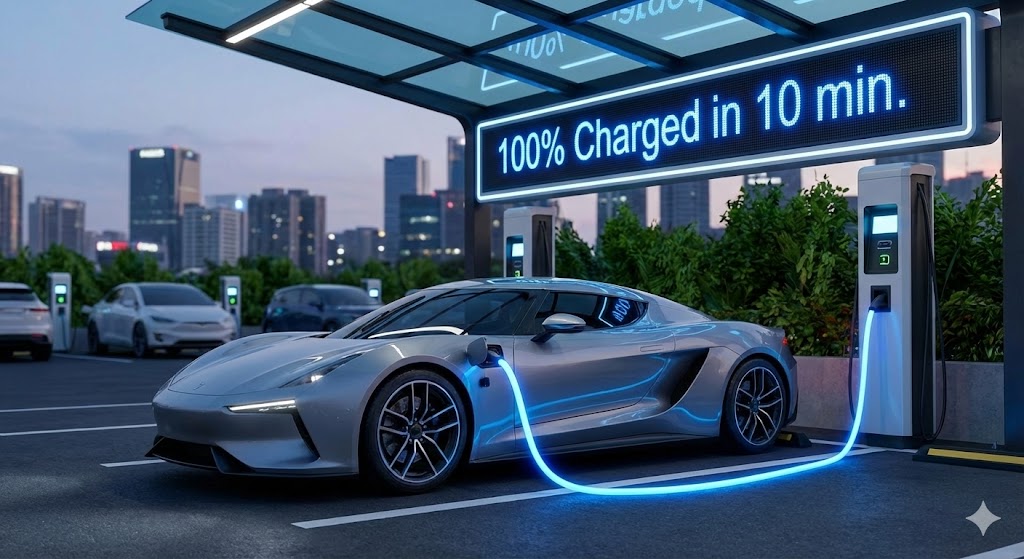
I have lost count of how many headlines I have read over the past five years telling me that solid-state batteries are about to change everything. Every year, Toyota announces a new timeline. Samsung SDI presents impressive lab specs at a trade show. A startup raises $200 million. And then nothing arrives at a dealership.
So when someone asks me whether solid-state batteries will finally kill range anxiety and make electric vehicles dominant, my honest answer is: probably, eventually, but not on the schedule anyone is advertising. The technology is real. The engineering challenges are real. And the gap between a working prototype and a mass-produced battery you can buy in a car is wider than most coverage suggests.
Here is where things actually stand as of early 2026.
What a Solid-State Battery Actually Changes
The core idea is straightforward. Current lithium-ion batteries use a liquid electrolyte to shuttle ions between the anode and cathode. That liquid works, but it creates problems: it is flammable, it degrades over time, it limits how fast you can charge, and it allows the formation of dendrites — tiny metallic growths that can short-circuit the cell and cause fires.
A solid-state battery replaces that liquid with a solid material — typically a ceramic, sulfide, or oxide compound. This change enables several improvements that, on paper, are dramatic. Energy density roughly doubles or triples compared to current lithium-ion cells, because you can use a lithium metal anode instead of graphite. Charging speed increases because solid electrolytes can handle higher current without the same degradation risks. Safety improves because the solid electrolyte is non-flammable. And cycle life extends significantly — Toyota has publicly targeted 90% capacity retention after 40 years of typical use, compared to roughly 10 years for current lithium-ion packs. (Source: InsideEVs, November 2025)
On paper, this is a generational leap. In practice, the gap between paper and pavement is where all the trouble lives.
Who Is Building What — and When
Let me walk through the major players and their actual status, not their press release promises.
Toyota remains the most aggressive major automaker. At the 2025 Japan Mobility Show, Toyota confirmed it is targeting 2027 to 2028 for its first solid-state battery EV, with the technology promising a roughly 1,200-kilometer range and a 10-minute charge time. Toyota is partnering with Idemitsu Kosan to produce lithium sulfide, a key raw material, at a new facility capable of 1,000 metric tons annually by 2027. This is part of a broader Japanese consortium investing roughly 1 trillion yen (about $7 billion) in domestic EV battery production. (Source: Electrek, October 2025)
But context matters. Toyota originally planned to launch solid-state batteries in 2020. That was pushed to 2023, then 2026, now 2027 to 2028. Every deadline has slipped. The technology is advancing, but Toyota’s track record on this specific timeline should be evaluated with that history in mind.
Samsung SDI demonstrated a prototype at InterBattery 2024 with specifications of 500 Wh/kg energy density and 900 Wh/L volumetric density — numbers that would roughly double the energy density of current EV batteries. Samsung has promised 80% charge capability in 9 minutes by 2027. These are impressive lab numbers, but Samsung SDI has not yet announced a mass production date or a specific vehicle partnership for deployment. (Source: To7Motor, February 2026)
QuantumScape, the publicly traded startup that generated enormous investor excitement (and an enormous stock price collapse), is further along than it was two years ago but still pre-commercial. Its QSE-5 cells have demonstrated 844 Wh/L energy density and 301 Wh/kg. The company began shipping B-samples to launch customers in 2025, with field testing starting in 2026. That is genuine progress, but field testing is not commercial production, and the company has repeatedly adjusted its timelines since going public. (Source: Undecided with Matt Ferrell, November 2025)
The most tangible commercial progress right now is coming from China, but with a caveat: what Chinese manufacturers are shipping is mostly semi-solid-state batteries — hybrid designs that use 5 to 15% liquid electrolyte alongside solid components. These are real products in real vehicles. Nio and IM Motors already sell cars with semi-solid cells offering 300 to 360 Wh/kg energy density. MG has taken pre-orders for a vehicle with a semi-solid-state battery priced under $15,000. These are significant milestones, even if they fall short of the “pure” solid-state vision. Dongfeng is planning 350 Wh/kg mass production by late 2026.
Mercedes-Benz provided perhaps the most concrete demonstration when it drove an EQS equipped with a solid-state battery 749 miles on a single charge. That is a real vehicle on a real road covering a real distance — and it is the kind of evidence that matters more than any press conference slide deck.
The Cost Problem Nobody Wants to Highlight
Here is the number that most optimistic coverage buries: current solid-state battery prototypes cost $400 to $800 per kilowatt-hour. For comparison, conventional lithium-ion batteries have dropped below $100 per kWh and are approaching $80 in some configurations.
That means solid-state batteries are currently 4 to 10 times more expensive than the batteries they are supposed to replace. Even assuming aggressive manufacturing scale-up, industry projections suggest solid-state costs reaching $150 to $200 per kWh by 2030, and cost parity with lithium-ion perhaps by 2035.
This has a direct implication for the “death of range anxiety” narrative. Yes, solid-state batteries can theoretically deliver 1,000-plus kilometer range. But if they cost five times more to produce, the vehicles they power will be priced for premium buyers, not mass-market consumers. The first solid-state EVs will likely be luxury models — think Lexus sports cars or high-end Mercedes, not the Toyota Corolla or Hyundai Kona.
For the mass market, range anxiety is already being addressed by a different force: the incremental improvement of conventional lithium-ion batteries combined with the rapid expansion of charging infrastructure. Most new EVs in 2025 and 2026 already offer 300 to 400 miles of range with lithium-ion packs. DC fast chargers can add 200 miles of range in under 20 minutes at many stations. That is not the revolutionary leap that solid-state promises, but it is good enough for the vast majority of driving scenarios.
The Actual Timeline
Based on what I can piece together from verified sources rather than press releases, here is a realistic timeline.
Right now through 2026: Semi-solid-state batteries are in limited production in China. Pilot-scale manufacturing of true solid-state cells is happening at companies like Factorial Energy, which opened what it calls the largest solid-state battery assembly line in the U.S. Lab testing and field trials continue at QuantumScape, Solid Power (partnered with BMW), and others.
By 2027 to 2028: Toyota, Samsung SDI, and possibly one or two Chinese manufacturers will introduce true solid-state batteries in low-volume, premium vehicles. These will be proof-of-concept commercial products, not mass-market offerings. China is set to release its first solid-state battery standard in July 2026, which will help formalize the technology for regulatory and commercial purposes.
By 2029 to 2030: Broader availability in multiple vehicle models, but still at a cost premium. Consumer electronics applications (smartphones, wearables) may arrive in this window.
After 2030: If manufacturing costs decrease as projected, solid-state batteries begin to enter mass-market vehicles. Cost parity with lithium-ion is the trigger event — and most realistic projections place that around 2033 to 2035.
What This Actually Means for Buyers
If you are waiting for a solid-state battery car before buying an EV, you are going to be waiting a long time for a mass-market option. The current generation of lithium-ion EVs is already good enough for the overwhelming majority of use cases. Range anxiety in 2026 is more psychological than practical for most drivers.
If you work in energy technology, materials science, or automotive manufacturing, the solid-state transition is worth watching closely — not because it is imminent, but because the manufacturing infrastructure being built now will determine competitive positions for decades.
And if you are an investor, I would pay more attention to the companies solving the manufacturing problem than the ones announcing impressive lab specs. The physics of solid-state batteries has been understood for years. The challenge has always been making them cheaply, consistently, and at scale. That is an engineering and industrial problem, not a science problem, and it is where the real value will be created.
—