Every few months, another headline announces that fusion energy is finally around the corner. A laser broke a record. A startup raised $900 million. A politician called it the future.
I have been following this space closely for several years now, partly because energy technology sits at the intersection of everything I cover — markets, geopolitics, and the tech that reshapes both. And I have noticed a pattern. The excitement tends to run far ahead of the engineering. So I decided to lay out what has actually happened in fusion energy over the past two years, who is spending what, and what the realistic timeline looks like based on current data — not press releases.
The Numbers That Matter
Let me start with the money, because that tells you something real about confidence levels.
According to the Fusion Industry Association’s 2025 Global Fusion Industry Report, private and public investors committed $2.64 billion to fusion companies in the 12 months leading up to July 2025. That brought cumulative sector funding to $9.77 billion — a five-fold increase since 2021. The number of companies responding to the FIA survey grew from 23 in 2021 to 53 in 2025, with eight new entrants in the past year alone. (Source: Fusion Industry Association, July 2025)
By September 2025, a separate report from the Fusion for Energy Observatory pegged cumulative global funding even higher, at roughly €13 billion (about $15.2 billion), reflecting major rounds that closed after the FIA survey period. (Source: Nuclear Newswire, December 2025)
The United States accounts for about 53% of all global private fusion investment, spread across 42 companies. China is second with roughly 34%, but its model is fundamentally different — about 71% of Chinese fusion funding comes from government sources, while the U.S. model is 94.5% private capital. The EU sits somewhere in between, with a hybrid of 64% private and 34% public funding.
These are serious numbers. But money does not bend plasma.
What the Labs Actually Achieved
The milestone that changed the conversation happened at the National Ignition Facility (NIF) at Lawrence Livermore National Laboratory in December 2022, when 192 lasers fired at a tiny fuel pellet and produced more fusion energy than the laser energy that went in. That was the first-ever demonstration of scientific ignition.
What matters more is what happened after. NIF did not just do it once and call it a day. By April 2025, the facility delivered 8.6 megajoules of fusion energy output — more than four times the 2.08 MJ of laser energy used to trigger the reaction. The team standardized the ignition process, making it repeatable rather than a one-off laboratory event. (Source: World Economic Forum, February 2026)
On the magnetic confinement side, China’s EAST tokamak — the one journalists keep calling the “artificial sun” — crossed a boundary that physicists had considered a hard limit for decades. In late 2025, the EAST team demonstrated stable plasma operation beyond the Greenwald density limit, which defines how much fuel you can pack into a tokamak before the plasma collapses. A theoretical framework called plasma-wall self-organization (PWSO) predicted this was possible, and the Chinese team proved it experimentally. (Source: ScienceDaily, January 2026)
In Germany, the Wendelstein 7-X stellarator — a different reactor design that uses twisted magnetic fields instead of the tokamak’s donut shape — hit its own record. In May 2025, it reached 1.8 gigajoules of energy turnover, up from 1.3 GJ in 2023. The stellarator approach trades the tokamak’s simplicity for inherent stability, and these results suggest the tradeoff might be worth it. (Source: Interesting Engineering, December 2025)
These are not startup marketing claims. These are peer-reviewed, government-backed experimental results.
The Private Sector Race
Now here is where it gets complicated — and where you need to separate engineering progress from fundraising narratives.
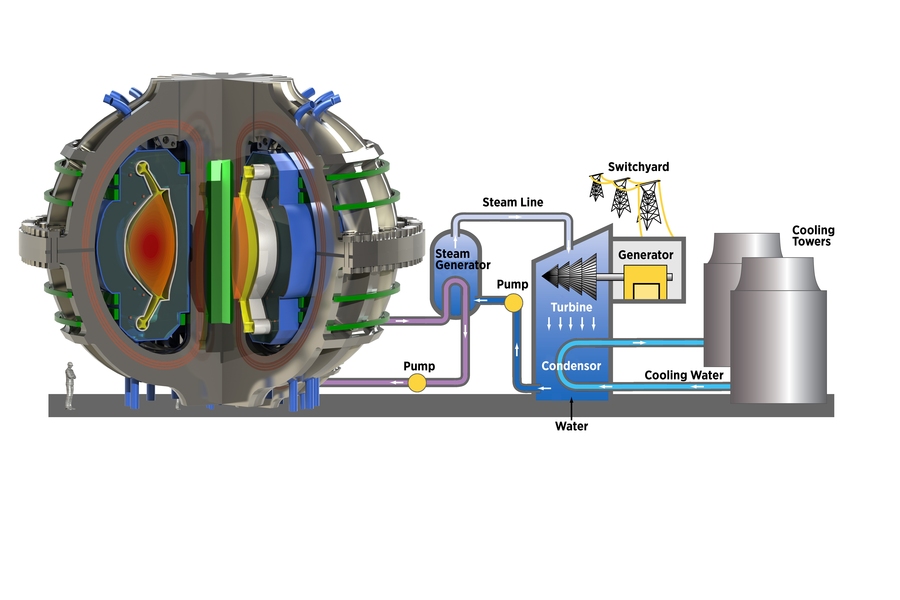
Commonwealth Fusion Systems (CFS) is the sector’s heavyweight. The Massachusetts-based company closed an $863 million Series B2 round in August 2025, bringing its total funding to nearly $3 billion — roughly a third of all private fusion capital worldwide. CFS is building SPARC, a demonstration tokamak that uses high-temperature superconducting (HTS) magnets to create stronger magnetic fields in a smaller machine. Investors include Google, Breakthrough Energy Ventures, and Morgan Stanley’s Counterpoint Global. (Source: Commonwealth Fusion Systems, August 2025)
Helion Energy is taking probably the most aggressive approach. Backed by Sam Altman and Reid Hoffman, Helion plans to deliver electricity from fusion by 2028, with Microsoft as its first contracted customer. In July 2025, the company began site work in Malaga, Washington, for Orion, which it aims to be the world’s first commercial fusion power plant. Helion uses a field-reversed configuration reactor — essentially an hourglass-shaped device where two plasma rings collide at over a million miles per hour. Total funding has passed $1 billion.
Pacific Fusion came out of stealth with a $900 million Series A — the largest initial raise in fusion history. Led by Eric Lander, the scientist behind the Human Genome Project, Pacific Fusion pursues pulsed magnetic inertial fusion rather than the more established laser or tokamak approaches.
Then there is the merger that nobody expected. In December 2025, TAE Technologies — one of the oldest private fusion companies, founded in 1998 — announced it would merge with Trump Media & Technology Group in an all-stock deal valued at $6 billion. Whatever your opinion on the politics, the deal signals that fusion has entered mainstream financial territory.
ITER: The Elephant in the Room
Any honest assessment of fusion has to address ITER, the 34-nation collaborative project being built in southern France. ITER was supposed to be the definitive proof that magnetic confinement fusion can produce net energy at scale, generating 500 megawatts of fusion power from 50 MW of heating input.
The reality is less triumphant. After years of construction delays and budget overruns, research operations are now projected to begin in 2034, with full-scale fusion reactions targeted for 2039. The U.S. government’s FY 2026 budget request actually reduced ITER funding as part of a strategic reassessment of how the project fits into America’s broader fusion strategy. (Source: U.S. Department of Energy FY 2026 Budget Request)
Meanwhile, the DOE released a Fusion Science and Technology Roadmap in October 2025, signaling a shift toward supporting private-sector timelines rather than relying solely on ITER. The roadmap focuses on scaling up domestic fusion companies for commercial deployment by the 2030s through public-private partnerships. (Source: U.S. Department of Energy, October 2025)
The Honest Reality Check
Here is where I part ways with most fusion coverage.
Yes, NIF achieved ignition. But NIF’s laser system consumes roughly 300 MJ of electrical energy to produce that 2 MJ laser pulse. The “net energy gain” is measured only against the laser energy hitting the target, not the total energy the facility uses. Building a power plant around inertial confinement means solving the efficiency problem by orders of magnitude.
Yes, private companies have aggressive timelines. But when the FIA surveyed its members, the companies identified several unsolved challenges that must be addressed before 2030: achieving sufficient fusion power gain in a sustained commercial cycle, developing tritium breeding and fuel cycle sufficiency, and creating materials that can survive years of neutron bombardment inside a reactor. These are not minor engineering tweaks. These are fundamental materials science and plasma physics problems.
And yes, $9.7 billion sounds massive. But the FIA’s own report estimates that fusion companies collectively need roughly $77 billion in total investment to reach commercial deployment. We are at about 13% of the way there in terms of capital alone — and capital is the easy part.
Why It Still Matters
So if I sound cautious, why have I spent 2,000 words on this topic?
Because the progress in the last three years is genuinely different from the previous five decades. The joke used to be that fusion was always 30 years away. What changed is not the physics — it is the engineering ecosystem around it. High-temperature superconducting magnets, AI-driven plasma control systems, advanced manufacturing techniques, and a wave of private capital that did not exist before 2020 have collectively shortened the realistic timeline.
The FIA reports that 84% of surveyed fusion companies believe electricity from fusion will reach the grid before the end of the 2030s. That is optimistic, and I would personally bet on the 2040s for meaningful commercial deployment. But even the conservative end of that range represents a transformation in how we power civilization.
Fusion will not save the climate by 2035. It is not going to make electricity free overnight. And it will not replace the need for solar, wind, and battery storage in the near term. But as someone who watches energy markets and technology convergence professionally, I can say this: the question has shifted from “will fusion ever work” to “who gets there first, and how do we build the supply chain around it.”
That is a fundamentally different conversation than the one we were having ten years ago. And it is worth paying attention to.
—