My grandfather died at 71. His father made it to 68. Growing up, I sort of assumed that was just what men in my family did — worked hard, got sick somewhere in their late sixties, and died. It felt like a fixed timeline.
Then I started reading the research that has come out of longevity science in the past few years. And I genuinely do not know what to make of the timeline anymore.
I want to be careful here, because this field attracts more breathless hype than almost any other area of science. For every legitimate research paper, there are ten wellness influencers selling you a supplement stack and a $300 course on “biohacking your way to 120.” So let me be specific about what has actually been demonstrated, what is still in early trials, and what remains genuinely uncertain.
Senescent Cells: The Research That Made Biologists Rethink Aging
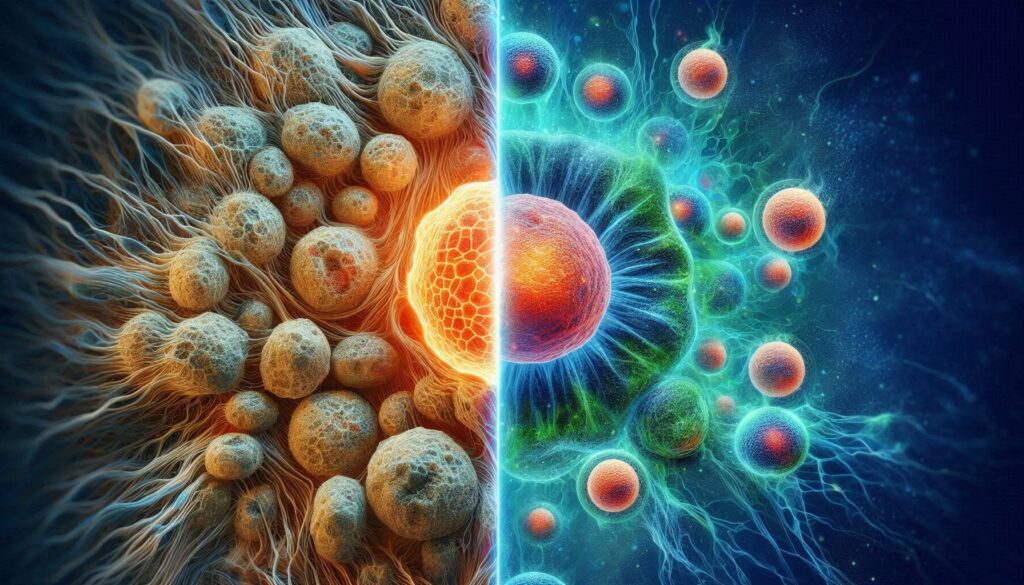
A few years ago I came across a term I had never heard before: “zombie cells.” The formal name is senescent cells, and the reason the nickname stuck is that they behave like cells that should have died but did not. They stop dividing, stop functioning, but also refuse to be cleared away by the immune system.
The problem is what they do while they linger. Senescent cells release a stream of inflammatory proteins — researchers call it SASP, which stands for Senescence-Associated Secretory Phenotype, a mouthful that basically means “chronic low-grade inflammation factory.” This type of inflammation has been linked to cardiovascular disease, neurodegeneration, joint deterioration, and several cancers. The term some researchers use is “inflammaging,” and it may be the most important concept in modern aging biology.
The interesting question became: what if you could clear these cells out?
That is what senolytic drugs attempt to do — selectively destroy senescent cells while leaving healthy tissue alone. The most studied combination is Dasatinib and Quercetin, originally a cancer drug paired with a plant compound. In mice, clearing senescent cells restored physical function, improved cardiovascular markers, and extended median lifespan by around 36% in some studies. Those are mice, not humans, and the translation from rodent studies to human outcomes has a long and humbling history of disappointment in medicine.
But the human trials are happening. Unity Biotechnology and a handful of other companies are running Phase II trials for specific conditions like osteoarthritis and eye disease. Early data on physical function and inflammation markers is genuinely encouraging, though the trials are still relatively small. The question researchers are trying to answer is whether periodic clearance of senescent cells can produce meaningful improvements in how people feel and function as they age — not whether it makes anyone live to 150.
Epigenetic Reprogramming: Rewinding the Clock Without Losing the Data
Here is something that surprised me when I first learned it: your DNA sequence does not actually change much as you age. What changes is the layer of chemical modifications sitting on top of the DNA — the epigenome — which controls which genes are active and which are silenced.
Think of it like a set of dimmer switches throughout your genome. When you are young, the right switches are at the right levels. As you age, some drift in the wrong direction: genes that should be on go quiet, genes that should stay quiet start expressing. The cumulative effect of these errors is what biologists increasingly think aging actually is, at the molecular level.
What made headlines a few years ago was the discovery that these changes might not be permanent. Using a set of reprogramming factors originally discovered in stem cell research (named Yamanaka factors, after Shinya Yamanaka who won a Nobel Prize for the work), researchers demonstrated that they could push aged cells toward a younger epigenetic state — without turning them back into undifferentiated stem cells, which would obviously cause problems.
David Sinclair’s lab at Harvard published work in 2023 showing they restored vision in blind mice by resetting the epigenetic age of retinal cells. The cells were old. They reset them. The mice could see again.
That is remarkable. It is also mice, and the translation challenge is enormous. Partial reprogramming in a living human involves risks that nobody fully understands yet, including the possibility of inadvertently driving cells toward cancer-like states. The clinical trials that are beginning in 2025-2026 are extremely early stage and focused on narrow applications. But the underlying biology is real, and the implications if it scales to humans are hard to fully process.
One practical thing that has already come from this research: epigenetic clocks. These are tools that measure your biological age — not the number on your birth certificate, but the actual methylation pattern of your DNA — with surprising precision. A 45-year-old can have the epigenetic profile of someone significantly younger or older depending on lifestyle, stress, sleep, and other factors. Biological age is becoming a real, measurable number. What you do with that measurement is a separate question.
GLP-1 Drugs: There Is a Bigger Story Than the Weight Loss Headlines
If you have followed the news at all in the past two years, you know about Ozempic and Wegovy. Most of the coverage has framed them as weight loss drugs — which is accurate but incomplete.
The cardiovascular data is what surprised the research community. A large trial called SELECT, involving over 17,000 patients, found that semaglutide reduced major adverse cardiovascular events by about 20% in people with existing heart disease who were overweight but not diabetic. That is a significant effect in a well-designed trial.
What makes this interesting from a longevity perspective is the breadth of effects showing up across different studies. Improved kidney function. Reduced liver inflammation in NASH patients. Signals in the Alzheimer’s data (still early, but present). Reduced C-reactive protein, a marker of systemic inflammation. Some researchers are cautiously noting that GLP-1 drugs seem to be hitting multiple aging pathways at once — not as a targeted intervention, but as a side effect of reducing visceral fat and chronic inflammation simultaneously.
The honest caveat: we do not yet have long-term data on what happens to people who take these drugs for 20 or 30 years. The mechanism for some of the benefits is still not fully understood. And accessibility is a genuine problem — these drugs are expensive, supply has been constrained, and the health systems that most need them are often least able to afford them. But the clinical evidence base is growing faster than for almost any drug in recent memory.
AI and Drug Discovery: The Part That Changes the Timeline Math
One thing that has genuinely shifted my thinking about how fast this field moves: AlphaFold.
In 2020, DeepMind published a solution to the protein folding problem — figuring out the 3D structure of a protein from its amino acid sequence — that researchers had been working on for 50 years. Within about two years, AlphaFold had predicted the structures of essentially every known protein. This is the kind of thing that makes drug development go faster, because understanding how a protein folds is fundamental to designing molecules that interact with it precisely.
I am not going to oversell AI in drug discovery, because there is a lot of hype here too. Turning a promising computational target into a drug that safely works in humans still takes many years and fails most of the time. But the rate at which new candidate molecules are being identified and synthesized has measurably accelerated. The longevity drug pipeline has more entries than at any point in history — which means some of them will work, and we will find out sooner.
The Microbiome Work That Deserves More Attention
This one gets less coverage than the more dramatic interventions, possibly because “bacteria in your gut” sounds less exciting than “turning back your biological clock.” But the research is quietly compelling.
A study published in Nature Aging found that transferring gut microbiota from young mice to old mice improved cognitive function and reduced inflammation markers in the aging animals. The gut-brain axis is real and increasingly well-documented. The composition of gut bacteria shifts as we age in ways that correlate with increased inflammation and declining immune function.
The practical implications are still being worked out, but fecal microbiota transplantation is already used clinically for recurrent C. difficile infections, and trials for aging-related applications are underway. The more accessible angle — targeted dietary changes, fermented foods, fiber diversity — has a solid evidence base for maintaining microbiome health even if it is not as dramatic as what the mouse studies suggest at the extreme end.
What I Actually Take From All of This
I started thinking about this topic because of my grandfather. I am not going to pretend that any of these interventions would have saved him, or that some combination of senolytics and epigenetic reprogramming is around the corner for most people.
What I think is true: the scientific consensus on whether aging is fundamentally modifiable has shifted in the past decade. It used to be a fringe idea. It is not a fringe idea anymore. Major research universities, serious peer-reviewed journals, and large pharmaceutical companies are all treating it as a legitimate research program. That does not mean the more dramatic claims will pan out. Many will not. But something real is happening in this field.
The most grounded version of what this means for most people right now is less about experimental drugs and more about what the research keeps confirming as the foundations: sleep quality matters more than most people act like it does, chronic low-grade inflammation is a genuine aging driver that diet and exercise measurably affect, and biological age — not chronological age — is the number worth paying attention to.
The more ambitious version, where partial reprogramming becomes a routine medical intervention sometime in the 2030s or 2040s, may or may not happen on any particular timeline. But it is no longer science fiction in the way it was even ten years ago. That seems worth knowing.
Sources referenced:
- Nature Aging — microbiome transfer studies
- SELECT trial data (semaglutide cardiovascular outcomes)
- Sinclair Lab, Harvard Medical School — epigenetic reprogramming research
- Unity Biotechnology — Phase II senolytic trial data
- AlphaFold / DeepMind protein structure database
This article is for informational purposes only and does not constitute medical advice. Consult a qualified physician before making any changes to your health or medical regimen.
If you found this guide helpful, check out our other resources: