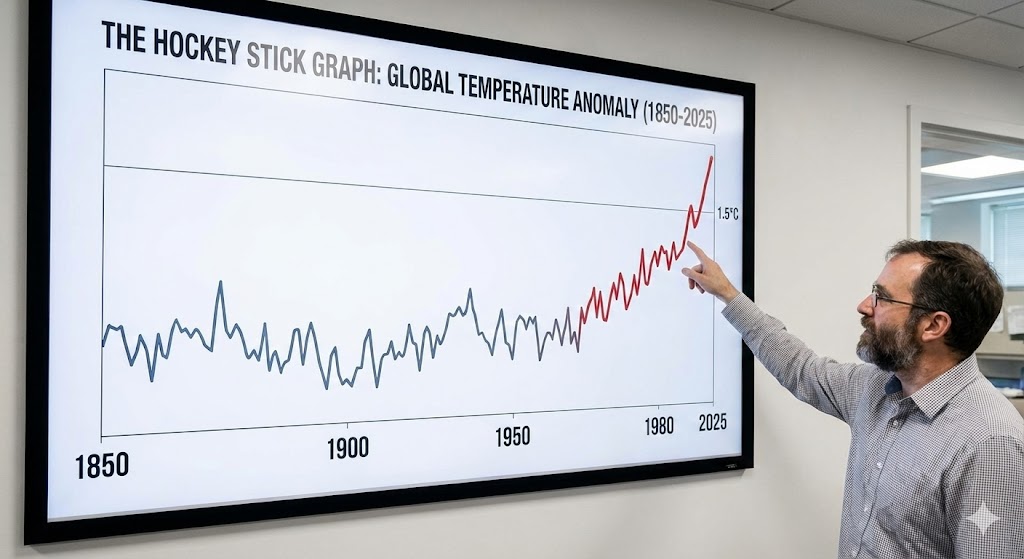
I am going to resist the temptation to write this article like it is a screenplay. There are enough climate pieces that read like disaster movie trailers. The data from 2025 is alarming enough on its own without theatrical language.
On January 14, 2026, the European Union’s Copernicus Climate Change Service released its annual report confirming that 2025 was the third-hottest year in modern history. The global surface air temperature was 1.47°C above the 1850-1900 pre-industrial baseline. This places it just behind 2024 (which holds the record at 1.60°C) and effectively tied with 2023. (Source: Copernicus, January 2026)
The more significant data point is this: the three-year average for 2023 through 2025 exceeded 1.5°C above pre-industrial levels for the first time in the instrumental record. This is the threshold that the 2015 Paris Agreement aimed to prevent breaching. While a three-year average is not the same as the long-term warming trend (climate scientists typically use 20 or 30-year periods), it represents a milestone that no amount of framing can soften.
What the Numbers Show
The past eleven years — 2015 through 2025 — have individually been the eleven warmest years in the 176-year observational record. That is not a statistical anomaly. It is a trend.
In 2025, air temperatures were above average across 91% of the globe. Over land, where humans live and directly experience climate impacts, global temperatures were 2°C above pre-industrial levels — the second highest on record. The Antarctic saw its warmest annual temperature ever recorded. The Arctic recorded its second warmest. (Source: Carbon Brief, January 2026)
Atmospheric CO2 concentration reached 423.9 parts per million in 2024, up 53% from the roughly 278 ppm in 1750. The year-over-year increase of 3.5 ppm was a record. Ocean heat content continued rising. Arctic sea ice extent after the winter freeze was the lowest on record. (Source: WMO, November 2025)
Why 2025 Was “Only” Third Warmest — and Why That Does Not Matter
Temperatures in 2025 were lower than 2024 partly because the strong El Niño that boosted 2023 and 2024 temperatures gave way to neutral and then La Niña conditions. La Niña typically dampens global temperatures. The fact that 2025 was still the third warmest year despite La Niña conditions tells you something about the underlying trend.
Scientists have also been investigating why 2023 and 2024 were unexpectedly hot — hotter than climate models predicted. Four factors have been identified as potential contributors: the El Niño event, a reduction in planet-cooling sulfur dioxide aerosols (down 40% over 18 years, partly due to a 2020 international shipping rule), the eruption of the Hunga Tonga undersea volcano in 2022, and the ongoing rise of greenhouse gas concentrations. The scientific debate is about the relative contribution of each factor, not about whether warming is occurring. (Source: Yale E360, January 2026)
The Human Cost in 2025
According to Climate Central, 2025 was the third most expensive year for major weather and climate disasters. Twenty-three events exceeded $1 billion in damage, causing 276 deaths and $115 billion in total damage in the United States alone. (Source: NBC News, January 2026)
The World Weather Attribution project identified 157 extreme weather events as “most severe” in 2025 based on criteria including more than 100 deaths, affecting more than half an area’s population, or triggering a state of emergency. Of the 22 events they closely analyzed, heat waves stood out as the world’s deadliest extreme weather category. Some heat waves studied were 10 times more likely than they would have been a decade ago due to climate change. (Source: PBS News, December 2025)
Half of the global land area experienced more days than average with “strong heat stress” — defined as a feels-like temperature of 32°C or above.
The 1.5°C Question
The Paris Agreement goal was to limit warming to 1.5°C above pre-industrial levels. Based on the current rate of warming, Copernicus estimates that this threshold for long-term global warming could be reached by the end of this decade — over a decade earlier than predicted when the agreement was signed.
The UN Environment Programme stated the situation plainly in its Emissions Gap 2025 Report: the multi-decadal average will very likely exceed 1.5°C within the next decade. Officials, scientists, and analysts have largely conceded that an overshoot is now virtually certain. (Source: Scientific American, January 2026)
That said, breaching 1.5°C is not the same as game over. The difference between 1.5°C and 2°C of warming is measured in millions of lives, trillions of dollars, and the survival of entire ecosystems. Every fraction of a degree still matters.
What Is Actually Being Done
Renewable energy deployment is accelerating globally. China is rapidly expanding solar and wind capacity. The EU has legally binding climate targets. Over 60% of healthcare executives anticipate increased investment in climate-resilient infrastructure.
But global CO2 emissions have not peaked. They continued rising through 2025. The relentless rise since 2020 rules out even theoretical routes to limiting warming to 1.5°C without overshoot. The 2025 UN Climate talks in Brazil ended without an explicit plan to transition away from fossil fuels.
From where I sit, the data does not support either despair or complacency. It supports urgency combined with realism. The physical trends are moving in a bad direction. The deployment of clean energy technology is moving in a good direction. Whether the second trend overtakes the first in time to matter is the defining question of this decade.
—