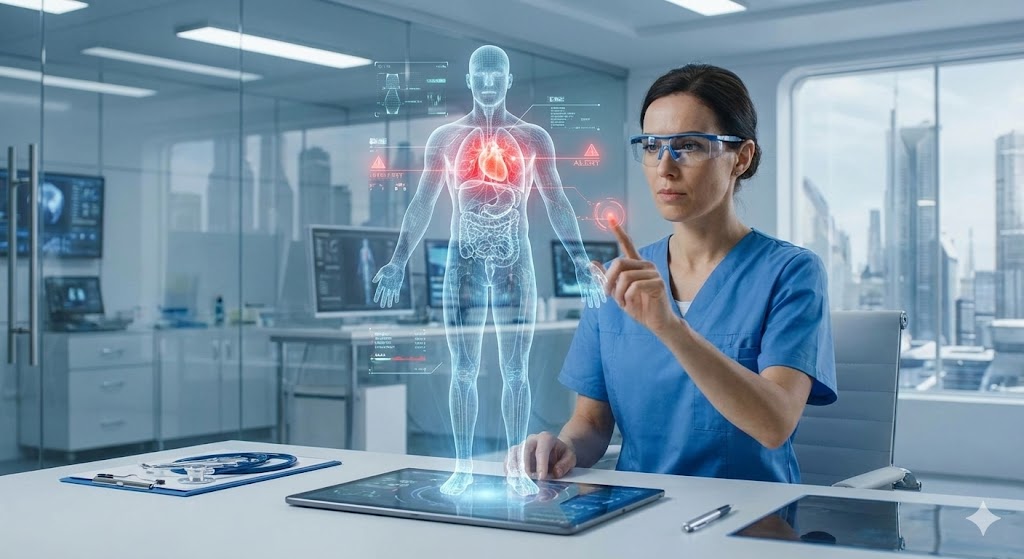
The concept of a medical digital twin — a continuously updated computational model of an individual patient, fed by real-time data from wearables, genomics, imaging, and electronic health records — is not science fiction. It exists, it has produced measurable clinical results, and major institutions from the MD Anderson Cancer Center to the Mayo Clinic to the NHS are actively developing it.
It is also, in most hospitals around the world, not yet something your doctor can use. Understanding both of those things at once is more useful than picking one side and running with it.
I have spent enough time around healthcare IT systems in my security work to know that the gap between a working prototype and a deployed clinical tool is where most promising technologies go to die. That gap is not about the algorithm. It is about data formats, vendor lock-in, regulatory timelines, and the fact that a hospital’s electronic health record system was probably last updated when the iPhone 6 was new. So when I look at digital twins, I look at the plumbing as much as the science.
Where the Technology Comes From
Digital twin technology was not invented for medicine. NASA used computational models to simulate spacecraft behavior remotely during the Apollo program, letting engineers diagnose and solve problems on missions millions of miles away before attempting physical intervention. The manufacturing sector picked it up next — GE, Siemens, and others built virtual replicas of jet engines and turbines to predict failures before they happened.
The translation to medicine became feasible when three things converged at roughly the same time: sufficient computing power to run real-time physiological simulations, wearable sensors generating continuous biological data outside clinical settings, and machine learning models capable of integrating heterogeneous data types — imaging, genomic, metabolic, behavioral — into a unified patient model.
None of those three enablers were mature simultaneously until roughly 2020 to 2022. The current wave of medical digital twin research largely reflects work done in the last four years, which explains both why the results are promising and why routine clinical deployment remains limited.
What the Clinical Evidence Actually Shows
The peer-reviewed literature is now substantial enough to draw measured conclusions. A comprehensive review published in Frontiers in Digital Health in November 2025 by researchers at MD Anderson Cancer Center examined the implementation of digital twins across different physiological levels, from cellular to whole-body systems. The findings are significant in specific domains — and conspicuously thin in others. (Source: Frontiers in Digital Health, November 2025)
Cardiology is the clear leader. The platform HeartFlow, which uses CT angiography data to estimate coronary blood flow non-invasively, has demonstrated clinical benefit across several trials and is commercially available. InHEART received FDA clearance in March 2024 for its AI-powered cardiac segmentation software and reported up to a 60% reduction in ventricular tachycardia procedure times with a 38% decrease in recurrence rates compared to conventional methods.
A separate study on heart failure patients found that digital twin models predicting patient responses to medications produced a 25% improvement in outcomes compared to standard care. In cardiac resynchronization therapy, a retrospective study of 260 patients showed model predictions aligning with clinical results in over 70% of cases. (Source: PMC/Frontiers, October 2025)
These are not trivial numbers. In cardiology, where care is heavily reactive and sudden cardiac events remain a leading cause of preventable death, a validated tool that reduces arrhythmia recurrence by 13 to 38 percent in treated populations is a meaningful clinical advance.
But cardiology is also where the evidence trail mostly ends, at least for now. In oncology, neurology, and metabolic disease, the work is largely pre-clinical or confined to pilot programs. The promise is real. The proof is still accumulating.
The Money Tells Its Own Story
Here is where the picture gets more interesting. The healthcare digital twin market was valued at approximately $2.1 billion in 2024 and is growing at a compound annual rate of roughly 27%, according to multiple market analyses published in late 2025. Projections for 2030 range from $7 billion to over $11 billion depending on the research firm, but the directional trend is consistent: this sector is attracting serious capital. (Source: PharmiWeb / MediTech Insights, February 2026)
In August 2025, the U.S. National Science Foundation, the National Institutes of Health, and the FDA jointly awarded over $6 million across seven research projects under a new program called FDT-BioTech — Foundations for Digital Twins as Catalyzers of Biomedical Technological Innovation. The projects cover cardiovascular device modeling, neurodegenerative disease simulation, glucose metabolism in Type 1 diabetes, and statistical frameworks for ethical AI use. (Source: NSF, August 2025)
On the venture side, Unlearn AI raised a $50 million Series C round, bringing its total funding above $130 million. The company’s core product, PROCOVA, uses AI-generated digital twins to create synthetic control arms for clinical trials — essentially virtual placebo groups that reduce the number of real patients needed in a control arm. The technology has been qualified by the European Medicines Agency for use as the primary analysis method in Phase 2 and 3 clinical trials, and the FDA has confirmed its alignment with current statistical guidance. (Source: Unlearn.ai)
Twin Health raised another $50 million to scale its Whole Body Digital Twin platform, which models a patient’s metabolic system to manage Type 2 diabetes and obesity. AstraZeneca has used over 300 million synthetic patient records in its digital trial infrastructure, reportedly reducing drug development costs by an estimated $100 million per drug. (Source: The Lancet Digital Health, May 202500007-X/fulltext))
Over the past four years, total investment in healthcare digital twin companies globally has exceeded $6.5 billion. North America accounts for roughly 47% of the market, with the Asia-Pacific region growing fastest.
The Gap Between Lab and Bedside
Here is where my IT security background makes me more cautious than the average tech optimist. The barriers to widespread adoption are not primarily technical. They are infrastructural, regulatory, and deeply institutional.
Data integration remains the immediate bottleneck. A meaningful patient digital twin requires inputs from electronic health records, imaging systems, lab results, wearable devices, and genomic data. In most hospital environments, these systems do not talk to each other cleanly. They store data in different formats, run on different platforms, and are maintained by different vendors. Interoperability standards exist — HL7 FHIR is the current framework — but implementation is patchy and hospital IT infrastructure varies enormously between institutions.
I have worked with healthcare clients whose radiology department runs on one system, cardiology on another, and the EHR on a third, none of which were designed to share data in real time. Building a digital twin in that environment is not an algorithm problem. It is a plumbing problem. And plumbing problems in healthcare IT take years to fix because every change has to go through compliance review, vendor negotiation, and staff retraining.
Then there is the regulatory question. A digital twin is not a drug with a measurable dose and a defined mechanism. It is a computational model whose predictions depend on the quality of its inputs, the accuracy of its physiological assumptions, and the representativeness of its training data. Demonstrating that a specific model is safe and effective for a specific clinical application requires a validation framework that regulatory bodies are still actively developing. The FDA has published guidance on computational modeling in medical device submissions and established a Digital Health Center of Excellence, but the regulatory pathway for patient-specific predictive models remains undefined in many areas.
And perhaps most significantly: privacy. A comprehensive digital twin requires precisely the kind of continuous, granular personal health data that privacy regulations like HIPAA and GDPR were designed to protect. Around 40% of healthcare professionals report concerns about data privacy, ownership, and governance related to digital twin implementations. These are not abstract objections. They are legal constraints that will shape how and where this technology can be deployed.
What Happens Next
The honest timeline looks something like this.
In cardiology and surgical planning, digital twins are already in limited clinical use and will expand over the next two to three years. Platforms like HeartFlow and inHEART have regulatory clearance and commercial traction. Expect more FDA submissions in this space through 2026 and 2027.
In clinical trials, digital twin technology is moving fastest. Unlearn AI’s regulatory qualification in both Europe and the U.S. means that pharmaceutical companies can start using synthetic control arms now. This has the potential to cut trial enrollment requirements by up to 50%, which translates directly into faster drug development and lower costs. If you are watching any single application, watch this one.
For the full vision — a comprehensive digital twin of an individual patient, continuously updated and used to guide treatment decisions across multiple conditions — the realistic timeline is the mid-2030s at earliest, and probably later. The data integration, regulatory framework, and privacy architecture required to support that vision do not yet exist in most healthcare systems.
That is not a criticism. It is an observation about the pace at which complex healthcare infrastructure actually changes. The science is ahead of the system it needs to plug into. And in medicine, unlike tech, you cannot ship a beta version and fix bugs later.
—