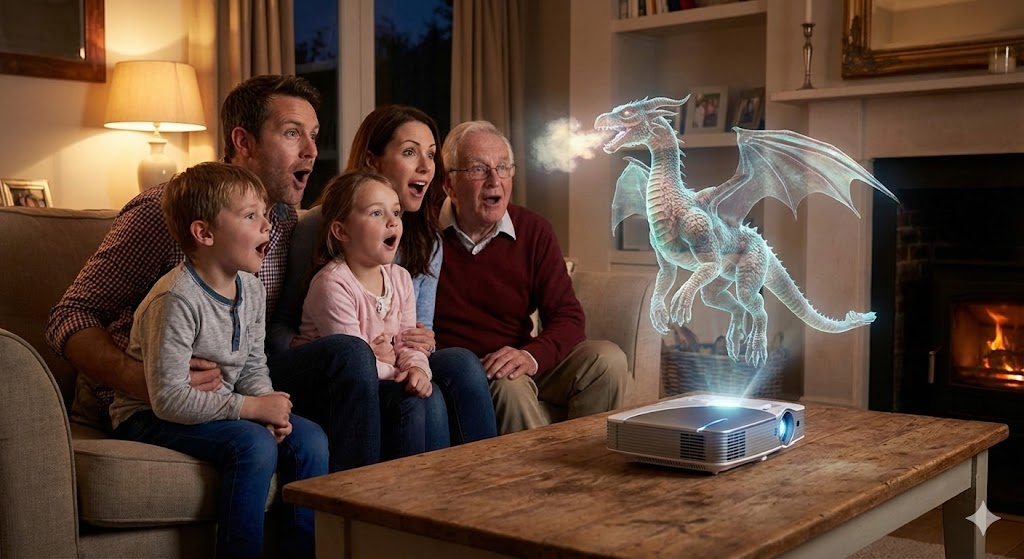
If you have been reading tech headlines, you might believe that flat screens are dying and holograms are taking over your living room. That is not happening. What is happening is more interesting and more complicated than the headlines suggest — and it starts with understanding that the word “holographic” in consumer tech marketing almost never means what scientists mean by holography.
I have been tracking display technology as part of my broader interest in how physical and digital security intersect. The display you look at determines how you perceive information, and the shift from 2D to spatial displays has implications for everything from security monitoring to social engineering. So I pay attention to what is actually shipping versus what is being demoed on stage.
What “Holographic” Actually Means — and What It Does Not
True holography involves recording and reconstructing light fields so that images possess real depth, parallax, and perspective as you move around them. This requires capturing light from every angle and reproducing it with enough precision that your brain perceives a genuine three-dimensional object floating in space. The computational and optical requirements for this are enormous, and in 2026, real-time true holography at consumer price points does not exist.
What does exist are several technologies that create convincing 3D effects without headsets or glasses, each using different techniques and each with different limitations. Light field displays, autostereoscopic screens, and the newly named “Hololuminescent” displays all deliver some degree of perceived depth, but they are fundamentally different from what you see in science fiction. (Source: TechGenyz, January 2026)
What Actually Shipped in 2025
The most significant product launch in this space came from Looking Glass Factory, a Brooklyn-based company that has been building glasses-free 3D displays for over a decade. In September 2025, they unveiled what they call the Hololuminescent Display — a new category they say combines a high-resolution 2D panel with a proprietary holographic etching layer that manipulates light to create perceived depth. (Source: Looking Glass Blog, September 2025)
The displays shipped in Q4 2025 at three sizes: a 16-inch model starting at $1,500, a 27-inch 4K version at $3,000, and an 86-inch version at $15,000 shipping in February 2026. They are under an inch thick, work with standard video content, and do not require eye tracking or special glasses. They are compatible with standard CMS and digital signage infrastructure. (Source: Tom’s Hardware, September 2025)
Looking Glass also continues to sell its light field displays — the 16-inch and 27-inch models designed for 3D creators, engineers, and developers. These generate up to 100 views of a 3D scene, allowing groups to see depth and parallax simultaneously. The U.S. Space Force is using them for satellite data visualization. They connect to standard computers and support Unity, Unreal, and Blender workflows.
Sony has its Spatial Reality Display, which uses eye tracking and a lenticular lens to present convincing 3D to a single viewer. It is impressive in person but limited to one user at a time, which restricts its practical applications to individual workstations rather than group viewing.
These are real products you can buy today. They are also primarily professional and enterprise tools, not consumer living room replacements for your television.
The Honest Technical Limitations
Here is where the marketing and the physics diverge. Current holographic and light field displays face several fundamental constraints that will not be solved by next year’s product cycle.
Resolution trades off against depth. As you increase the number of viewing angles, image sharpness drops. Current displays cannot match the clarity of a conventional 4K or 8K flat screen while simultaneously delivering spatial depth. For fine text, detailed interfaces, or long-distance viewing, flat screens remain superior.
Computational requirements are heavy. Even in 2025, real-time 3D holographic rendering strains high-end GPUs. Scaling this to consumer-friendly hardware that fits inside a television remains a significant engineering obstacle.
Energy consumption is a problem for portability. Prototypes that produce compelling spatial effects require significantly more power than flat panels, limiting battery-powered applications.
And critically, there is a content problem. Even if perfect holographic displays existed tomorrow, the vast majority of content — movies, games, web pages, documents — is created for flat 2D screens. Building a holographic content ecosystem requires new tools, new workflows, new creative skills, and new distribution infrastructure. That ecosystem barely exists outside of specialized 3D modeling communities.
The Market Context
The light field display market is growing, but from a very small base. Industry analyses project significant growth rates over the next decade, driven primarily by enterprise applications: medical imaging for surgical planning, engineering visualization, retail signage, and military applications. Consumer adoption remains years away, limited by cost, content availability, and the simple fact that a flat 4K OLED television at $800 delivers a better viewing experience for 99% of current content than a $3,000 light field display.
Looking Glass itself seems to understand this. Their Hololuminescent Display is explicitly positioned for marketers, retailers, and venues — environments where attention capture justifies premium pricing. They are not advertising it as a TV replacement.
What This Means Going Forward
The honest timeline for holographic displays looks something like this. Professional and enterprise applications will expand steadily through 2026 and 2027, with medical, engineering, and retail signage leading adoption. Consumer awareness will increase as the technology appears in public venues and retail environments. A mainstream consumer holographic television — one that matches current flat panel quality while adding spatial depth, at a comparable price — is likely a 2030s proposition at the earliest, dependent on breakthroughs in both display physics and content creation toolchains.
The flat screen is not dead. It is not even sick. But the first commercially viable alternatives are now shipping, and that is worth paying attention to — as long as you understand the gap between what is being sold and what is being promised.
—