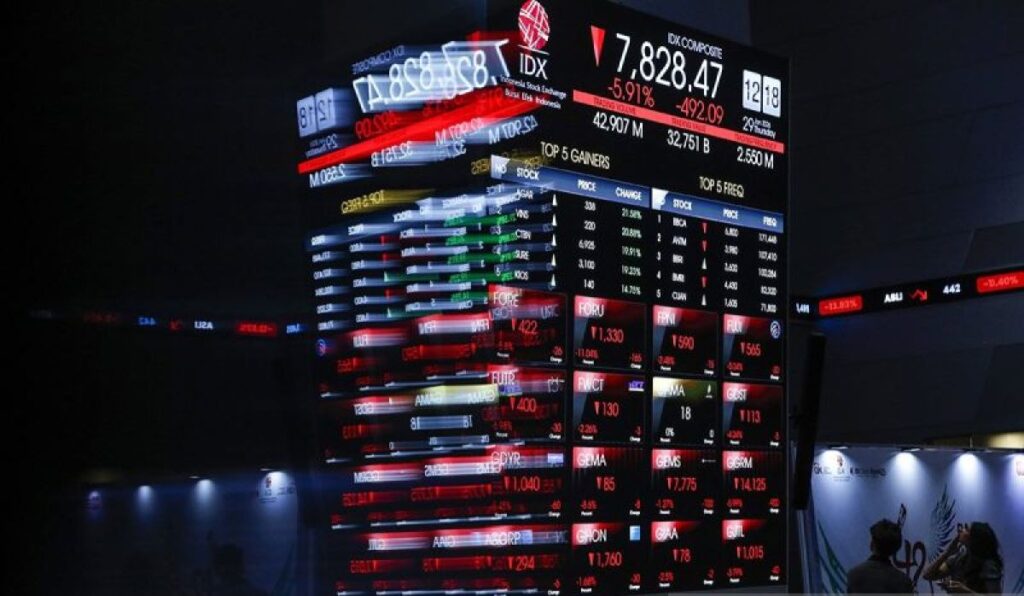
I follow Indonesia’s stock market with more than casual interest. Not as an active trader, but because the Jakarta Composite Index tends to reflect things that matter beyond its price level: how foreign institutional investors perceive Indonesia’s governance, how serious the regulatory environment actually is, and whether the country is building toward the kind of capital market credibility that attracts long-term money rather than short-term speculation.
What happened on January 28–29, 2026 was not a routine correction. It was the convergence of several structural problems that had been building for years, finally breaking through in two days of genuinely ugly trading.
What Happened on January 28–29
On Tuesday, January 27, Morgan Stanley Capital International (MSCI) announced what it called an “Interim Freeze” on several changes it had planned for Indonesia’s weighting in its global indexes. Specifically, MSCI froze all increases to the Foreign Inclusion Factor (FIF), halted the addition of new constituents to the MSCI Investable Market Indexes, and suspended upward migrations between index size segments.
The stated reason: continued concerns about transparency in ownership structure and abnormal trading practices that were distorting free float data on the Indonesia Stock Exchange (IDX).
The market’s reaction was immediate and severe. On Wednesday, January 28, the IHSG fell more than 8 percent — dropping from the 9,000-level range to around 8,250 — triggering a mandatory 30-minute trading halt mid-session. Transaction volume reached approximately IDR 18.8 trillion, with 703 stocks declining and only 61 advancing. The following day, selling pressure continued as the index broke below the psychological 8,000 level before beginning to stabilize.
In historical context, this was not Indonesia’s worst single-day decline. The IHSG collapsed below 6,000 in April 2025 during the Trump tariff shock that hit all emerging markets simultaneously. But the January 2026 crash had a different character: it was not caused by an external shock hitting all markets equally. It was caused by a specific question about the credibility of Indonesia’s own exchange.
Why the MSCI Decision Hit So Hard
To understand why an MSCI announcement could trigger a crash of this magnitude, it helps to understand what MSCI’s indexes actually represent in the global investment ecosystem.
MSCI manages benchmark indexes that passive funds and institutional investors around the world use as their reference. When a stock gains weight in MSCI’s Standard Index, funds tracking that index are effectively required to buy it. When MSCI freezes or reduces Indonesia’s weighting, portfolio managers globally who benchmark to MSCI must rebalance — which means selling Indonesian stocks.
The more serious risk sitting behind the Interim Freeze is the downgrade scenario: if Indonesia fails to address the free float transparency issues before MSCI’s May 2026 deadline, MSCI could downgrade Indonesia’s entire market classification from Emerging Market to Frontier Market. Market analysts estimate that this scenario could trigger outflows of approximately IDR 150 trillion from the Indonesian market as funds tracking Emerging Market benchmarks are forced to exit.
Indonesia’s Finance Minister Purbaya Yudhi Sadewa publicly characterized the market reaction as excessive and temporary. He stated that he had already coordinated with the Financial Services Authority (OJK) to resolve the transparency issues before the May deadline. “This is just a momentary shock,” Purbaya said. The statement helped stabilize sentiment to some degree — by mid-February, the IHSG had recovered to around the 8,300 level.
The “Fried Stock” Problem: Structural, Not Incidental
Saham gorengan — literally “fried stocks” — is the Indonesian market term for shares experiencing abnormal price and volume movement due to coordinated manipulation. It is not an official regulatory category, but it describes a practice that has become a recognized systemic problem at the IDX.
The typical mechanics: a coordinated group of market participants (bandar) buys small-cap stocks to artificially inflate prices, generates retail buying pressure through social media and investment forums, then exits their positions at elevated prices and leaves retail investors holding illiquid shares that are now declining.
The 2025-to-early-2026 period saw a record number of IPOs in Indonesia. Many of these were companies with weak fundamentals but compelling narratives — capitalizing on enthusiasm around green energy, AI, or downstream resource processing to generate first-day buying pressure. When MSCI explicitly cited manipulation and transparency as its reasons for the Interim Freeze, it provided formal external validation of what retail investors had been complaining about for years.
Law enforcement responded. Indonesia’s National Police Commercial Crime Directorate (Bareskrim) opened investigations into suspected market manipulation. In early February, the IPO of stock PIPA through Shinhan Securities became the first concrete case to move into prosecution, with three suspects named including a former IDX official.
The Full Call Auction Controversy
The Full Call Auction (FCA) mechanism is worth explaining because it became a focal point of criticism during the crash.
The IDX moves stocks to the FCA board when they are flagged as having abnormal trading activity. Under FCA, orders are collected over a defined period and then matched all at once, rather than being matched continuously throughout the trading day. The regulatory logic is sound: reducing the ability to manipulate prices in real time for already-problematic stocks.
The practical complaint from investors: FCA removes the visible bid-offer queue that exists on the main board. Investors cannot see where demand is sitting or what price will clear. For retail investors already holding stocks that have been moved to FCA, this creates a specific kind of anxiety — you cannot tell how bad the exit will be, which often causes people to sell earlier and more aggressively than they otherwise would.
Critics argue that FCA, whatever its intent, accelerated panic in affected stocks during the January crash rather than containing it. Reform of the FCA mechanism has become one of the concrete demands from the investor community in the post-crash discussions.
Why the Index Does Not Reflect Every Investor’s Experience
One paradox that Indonesian retail investors frequently observe: the IHSG looks green, but their portfolio is bleeding red. This is not a misperception.
The IHSG uses a market capitalization weighted methodology, which means its movement is dominated by a small number of large-cap issuers. When the big banking stocks — BBCA, BBRI, BMRI — are holding steady or rising, the headline index can appear healthy even while hundreds of small and mid-cap stocks are collapsing.
An investor whose portfolio is concentrated in small-cap or manipulated stocks can experience severe losses during periods when the IHSG appears broadly stable. This is not a flaw unique to Indonesia — market-cap weighted indexes are the global standard for good structural reasons — but it is important context for understanding why the crash of January 2026 felt more severe to many retail investors than the headline percentage suggested.
What to Watch for the Rest of 2026
Several developments will determine how this story resolves over the coming months.
The May 2026 MSCI deadline is the single most important near-term catalyst. If the government and OJK deliver meaningful improvements to free float transparency and the IDX can demonstrate credible enforcement against manipulation, MSCI has the grounds to lift the Interim Freeze. If the deadline passes without sufficient progress, the downgrade scenario becomes materially more likely.
Law enforcement consistency matters beyond any single case. The prosecution of the PIPA case is a signal, not a resolution. Whether Bareskrim and OJK sustain an aggressive approach to market manipulation over months rather than weeks will determine whether institutional investors update their view of Indonesia’s regulatory environment.
Rupiah stability is a downstream variable worth watching. Capital outflows from equities put pressure on the exchange rate — during the worst of the January selling, the Rupiah was holding around IDR 16,700 per USD. Sustained equity market stability reduces this pressure, while continued outflows could push the currency toward levels that make imported goods and foreign debt service more expensive.
Sectors with limited MSCI exposure may offer better near-term risk profiles than those with significant foreign institutional ownership. Stocks that were not under consideration for MSCI inclusion and have clean ownership structures face less systematic selling pressure from the rebalancing dynamic.
The Honest Summary
The January 2026 IHSG crash was not a freak event. It was the visible consequence of structural problems — manipulation tolerance, free float opacity, and governance deficiencies — that had been accumulating for years and were eventually flagged formally by a globally significant index provider.
IHSG has recovered from every major shock in its history, and mid-February data suggests this episode is following the same pattern. But pattern recognition is not the same as structural repair. The test of whether January 2026 was actually a turning point for Indonesia’s capital market credibility will be answered not by the index level in March, but by whether the enforcement actions and transparency improvements are real and lasting.
The May deadline with MSCI is not a formality. It is a genuinely consequential test that will either confirm or undermine the government’s stated commitment to cleaning up the market.
Sources referenced:
- MSCI Interim Freeze announcement, January 27, 2026
- CNBC Indonesia — trading halt coverage, January 28–29, 2026
- Kumparan — Finance Minister Purbaya Yudhi Sadewa statements
- Media Indonesia — Bareskrim investigation, PIPA case
- Bloomberg Technoz — IDX official definition of saham gorengan
- CNBC Indonesia Research — historical IHSG recovery analysis
This article is for informational and educational purposes only. Nothing in this article constitutes investment advice. Always conduct your own research and consult a qualified financial advisor before making investment decisions.