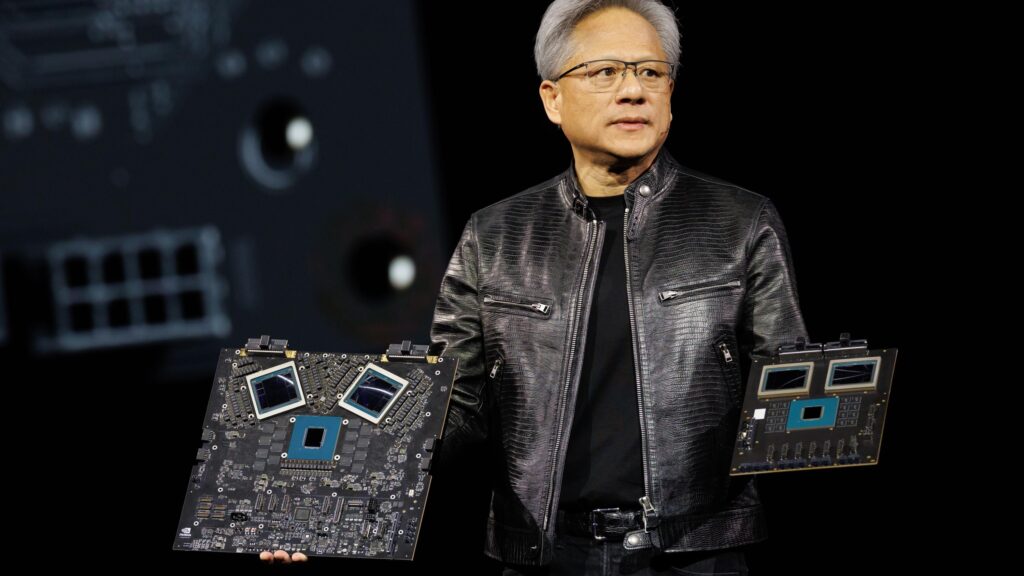
On December 8, 2025, President Trump announced via Truth Social that the United States would allow Nvidia to sell its H200 artificial intelligence chips to “approved customers” in China, with the U.S. government collecting a 25% cut. Trump added that Chinese President Xi Jinping had “responded positively.”
The announcement marked the most significant reversal of U.S. semiconductor export policy since the Biden administration implemented comprehensive controls beginning in October 2022. But the deal that emerged over the following weeks turned out to be considerably more complex than a single social media post suggested — involving novel legal mechanisms, logistical routing requirements, and a dual-approval system that gave both Washington and Beijing effective veto power over every shipment.
This article explains what the deal actually requires based on the formal rules published by the Bureau of Industry and Security, what has happened since, and what the arrangement means for the broader U.S.-China AI competition.
—
What the Commerce Department Actually Published
Trump’s Truth Social post framed the arrangement simply: approved customers, 25% revenue to the U.S., same deal for AMD and Intel. The Bureau of Industry and Security’s formal rule, published in January 2026, added several specific conditions.
Case-by-case licensing. BIS will now review export license applications for the Nvidia H200, AMD MI325X, and similar chips on a case-by-case basis. This is not a blanket approval. Each transaction requires individual Commerce Department review, and licenses can be revoked.
Third-party testing on U.S. soil. Every H200 destined for China must first be shipped from Taiwan — where TSMC manufactures them — to a verified third-party laboratory in the United States. The chips undergo performance and security verification before continuing to China. This routing through U.S. territory is what triggers the 25% tariff: when the chips enter the country for testing, they become subject to a Section 232 national security order that Trump signed the same day BIS published the rules.
Domestic supply sufficiency. Exporters must demonstrate that selling H200s to China will not reduce the global semiconductor production capacity currently available to U.S. customers. In practical terms, for every chip going to China, American buyers must be served first.
End-use certification and compliance. Chinese purchasers must have adopted export compliance procedures, including customer screening. Military applications, sensitive government agencies, critical infrastructure operators, and state-owned enterprises are excluded from purchasing.
Under Secretary for Industry and Security Jeffrey Kessler framed the approach as an evolution: permitting sales under controlled conditions while maintaining national security oversight.
—
The 25% Tariff: Legal Questions
The tariff structure has drawn significant legal scrutiny. A Lawfare analysis published in late January 2026 argued that the arrangement is potentially illegal under the Export Control Reform Act (ECRA), which expressly prohibits BIS from charging any “fee” in connection with issuing export licenses.
The administration’s legal theory relies on structural separation. The chips first enter the U.S. for testing, triggering an import tariff under Section 232. The tariff and the license application are technically separate actions. But critics note that the tariff was designed to apply only to chips moving through the China-license pathway — Trump’s own proclamation exempts virtually all other semiconductor imports, including chips for U.S. data centers, non-data center applications, R&D, and public-sector use. The only chips actually paying the 25% are those routed through U.S. territory specifically because of the testing requirement that Trump himself created.
As the Lawfare analysis noted, this effectively turns an export license into a revenue-extraction mechanism, regardless of how the paperwork is structured.
—
The China Side: Dual Approval, Dual Complications
The U.S. clearing the H200 for export was only half the story. China’s own regulatory apparatus created a second layer of approval requirements that caught many observers off guard.
Within days of Trump’s announcement, Chinese customs authorities told agents that H200 chips were not permitted to enter China, creating confusion for companies that had already placed orders. Beijing held what media reports described as “emergency meetings” to decide how to handle the situation.
The core of China’s dilemma was straightforward: its AI companies desperately needed the hardware, but Beijing was simultaneously pushing a self-reliance agenda in semiconductors. The H200 delivers roughly six times the performance of Nvidia’s H20 chip — the lower-tier processor Nvidia had designed specifically to comply with Biden-era restrictions — and far exceeds anything produced by Chinese domestic chipmakers, including Huawei’s Ascend line.
By late January 2026, Beijing began approving imports. Reuters reported that ByteDance, Alibaba, and Tencent received clearance for more than 400,000 H200 chips in total. The approvals came during Nvidia CEO Jensen Huang’s visit to China, though Huang himself publicly stated that China had not yet made a final decision on purchases.
The approvals came with conditions still being finalized. One proposal Beijing discussed would require each H200 purchase to be bundled with a set ratio of domestically produced chips — essentially forcing companies to buy Chinese semiconductors alongside American ones. Military and state-owned enterprises remained excluded. A fifth source told Reuters that the license conditions were so restrictive that approvals were not actually converting to purchase orders.
—
The Demand Picture
The scale of demand was remarkable. Chinese technology companies placed orders for more than two million H200 chips to be delivered in 2026, according to Reuters — far exceeding Nvidia’s available inventory of approximately 700,000 units. TSMC would need to begin additional production runs in the second quarter of 2026 to meet the demand.
Both Alibaba and ByteDance privately told Nvidia they wanted to order more than 200,000 units each. ByteDance alone was reportedly prepared to spend roughly $14 billion on Nvidia AI GPUs in 2026. At approximately $27,000 per chip, the initial approved batch of 400,000 units represented nearly $11 billion in potential revenue.
Nvidia responded to the regulatory uncertainty by requiring full advance, non-refundable payment from Chinese customers. If Beijing subsequently blocked imports, the financial risk would fall entirely on the buyers, not on Nvidia.
—
What the Deal Means for the AI Competition
The Council on Foreign Relations published an analysis on December 9 arguing that the decision could fundamentally alter the AI balance between the two countries. If Nvidia exports three million H200s to China in 2026 — a plausible scenario consistent with the percentage of revenue Nvidia received from China before export controls — this would at least triple China’s aggregate AI computing power additions for the year.
The analysis warned that this could enable Chinese AI developers like DeepSeek to close the gap with leading U.S. labs and help China build a competing AI infrastructure network globally.
White House AI czar David Sacks estimated that China’s AI sector lagged the United States by roughly three to six months before the deal. The gap had widened under Biden-era controls, but Chinese companies like DeepSeek, Baidu, and Alibaba had still managed to produce competitive models by optimizing for lower-tier hardware.
The paradox, as CFR noted, was striking: the Trump administration was aggressively using tariffs to reshore manufacturing while simultaneously lifting the export controls that had been restricting China’s development of AI infrastructure — what Nvidia CEO Jensen Huang had repeatedly called “the factories of the future.”
—
Congressional Pushback and Ongoing Uncertainty
The deal faces continuing legislative pressure. The House Foreign Affairs Committee passed the AI Overwatch Act in late January 2026, which would require manufacturers to secure an export license from the Secretary of Commerce for advanced AI chip exports to certain countries and impose a two-year ban on the sale of Nvidia Blackwell chips to China. The bill also introduces a 30-day congressional veto power over any semiconductor export license — creating permanent uncertainty for the supply chain, since licenses granted by Commerce could theoretically be revoked by the legislature.
Meanwhile, the commercial dynamics continued to evolve. Nvidia’s Blackwell and next-generation Rubin chips remain excluded from the deal. China’s Cyberspace Administration separately barred domestic firms from purchasing certain Nvidia products designed for the Chinese market, directing them to rely on local suppliers for some applications. The grey market for high-end chips — which had seen H200 servers trading at nearly $330,000 per node in late 2025 — was expected to stabilize with official channels opening.
—
Where Things Stand
As of mid-February 2026, the arrangement exists in a state of structured ambiguity. The U.S. has approved exports. China has approved initial imports for its three largest tech companies, with conditions still being finalized. More than 1.6 million additional chips remain pending approval. Congressional legislation could disrupt the framework at any time. And the fundamental tension — between America’s desire to collect revenue from chip sales and its strategic interest in maintaining a technology advantage — remains unresolved.
The deal is not a simple trade agreement. It is a novel experiment in what analysts have called “controlled dependency” — allowing China enough access to U.S. technology to generate revenue and maintain commercial relationships, while attempting to keep the most advanced capabilities out of reach. Whether that balance can hold as AI technology advances and the political dynamics in both countries continue to shift is the central question that no formal rule or tariff structure can answer.
—
Sources:
1. BIS — Commerce Department Revises License Review Policy for Semiconductors Exported to China (January 2026) 2. CNBC — Trump Greenlights Nvidia H200 AI Chip Sales to China (December 2025) 3. Council on Foreign Relations — The Consequences of Exporting Nvidia’s H200 Chips to China (December 2025) 4. Lawfare — Trump’s Illegal AI Chip Export Controls, and Who Can Challenge Them (January 2026) 5. Reuters via Yahoo Finance — China Gives Nod to ByteDance, Alibaba and Tencent to Buy Nvidia’s H200 Chips (January 2026) 6. Tom’s Hardware — China Expected to Approve H200 Imports in Early 2026 (January 2026) 7. Built In — Trump Lifted the AI Chip Ban on China: Now What? (Updated 2026)
Disclaimer: This article provides factual reporting on semiconductor export policy developments. It does not constitute investment advice. Export regulations are subject to change, and readers should consult official government sources for the most current rules. The situation described is evolving rapidly.