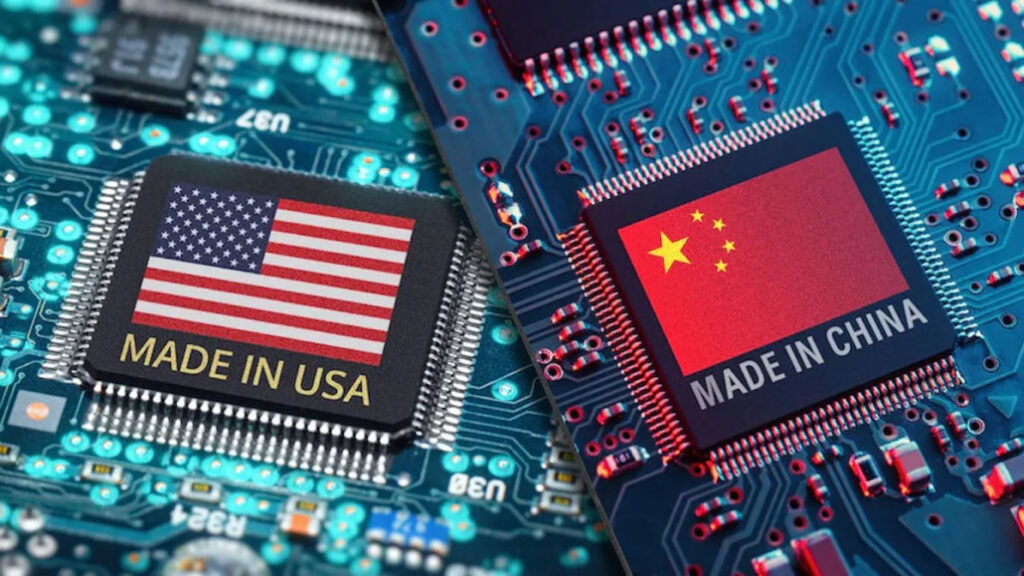
In December 2025, Reuters reported something that Western semiconductor policymakers had been hoping would not happen for at least another decade: China has built a functional prototype of an Extreme Ultraviolet lithography machine in a high-security laboratory in Shenzhen.
The machine is operational. It can generate EUV light at the 13.5-nanometer wavelength required for advanced chipmaking. It has not yet produced a working chip. And the gap between those two statements — generating light and printing functional silicon — is where the real story lives. (Source: Asia Times, December 2025)
I work in IT security, where the semiconductor supply chain is a direct national security concern. The chips in military systems, critical infrastructure, and communication networks depend on a manufacturing ecosystem that, until now, had one absolute chokepoint: ASML’s EUV machines. Understanding what China’s prototype means — and does not mean — matters beyond the tech industry.
What Reuters Actually Reported
The Shenzhen prototype was completed in early 2025 and is undergoing testing. It was assembled by a team that included former engineers from ASML, the Dutch company that holds a near-monopoly on EUV lithography. The team reverse-engineered aspects of ASML’s technology using components from older ASML machines obtained through secondary markets. (Source: TrendForce, December 2025)
Beijing has set a goal of producing functional chips using the machine by 2028. Sources told Reuters that 2030 is a more realistic target. Huawei is playing a central coordinating role, managing a network of companies and state research institutes across China involving thousands of engineers. Sources compared the effort to China’s version of the Manhattan Project. (Source: Asia Times, December 2025)
Two Competing Approaches
Interestingly, China appears to be pursuing EUV light generation through a different method than ASML uses. ASML employs Laser-Produced Plasma, using CO2 lasers supplied by its U.S. subsidiary Cymer to vaporize tin droplets. Chinese teams are working with Laser-Induced Discharge Plasma, which uses high-voltage electrical discharge rather than laser energy to create the plasma. This method is theoretically cheaper, more compact, and consumes less power.
Two research teams are working in parallel. One is led by Lin Nan, a former ASML scientist now at Beihang University, whose team published a paper in March 2025 reporting a conversion efficiency of 3.42% — slightly above the 3.2% achieved by the Advanced Research Center for Nanolithography in a comparable 2019 experiment. The second team, led by Zhao Yongpeng at Harbin Institute of Technology, is pursuing a similar approach. Both use solid-state lasers rather than the CO2 lasers ASML depends on. (Source: EE Times, December 2025)
A separate track, reported by DigiTimes, involves an LDP-based system being tested at Huawei’s Dongguan facility. Reports from early 2025 suggested trial production was planned for Q3 2025 with mass production targeted for 2026. These timelines are aggressive and should be treated with appropriate skepticism. (Source: DigiTimes/Global SMT, March 2025)
The Gap That Matters
Generating EUV light is not the same as printing chips. ASML’s EUV machines are systems of extraordinary complexity involving roughly 100,000 components, including mirrors so precisely engineered that if scaled to the size of Earth, their deviations would be less than the width of a human hair. ASML relies on an exclusive relationship with Germany’s Carl Zeiss for these optics, along with components from Cymer in the U.S. and a global network of specialized suppliers.
China’s prototype currently produces 50 to 100 watts of EUV power. Commercial-scale EUV lithography requires at least 250 watts for acceptable throughput. Beyond the light source, a production EUV system needs multilayer mirrors, photomasks, and specialized photoresists — all of which remain bottlenecks for China’s domestic production. China’s Changchun Institute of Optics is developing optical components, but Zeiss maintains a significant lead.
ASML CEO Christophe Fouquet said in April 2025 that China would need “many, many years” to develop production-ready EUV technology. The existence of a functional prototype suggests that assessment may need revision, but it does not invalidate the fundamental point: a prototype and a production system are different categories of achievement. (Source: WCCFTech, December 2025)
The Strategic Implications
Even before EUV, China has been building a dominant position in mature-node chip manufacturing. China currently holds roughly 33% of global production capacity for foundational-node chips (28nm and above) and is expected to build more new fab facilities between 2022 and 2026 than any other country. State-led semiconductor investment exceeds $150 billion.
The EUV prototype changes the strategic calculus not because it gives China immediate advanced chip capability, but because it signals that the “hard ceiling” theory — the assumption that export controls on ASML equipment would permanently lock China out of cutting-edge manufacturing — may not hold indefinitely.
The practical timeline is probably this: functional chips from the EUV prototype by 2028 at earliest, low-volume production capability by 2030, and competitive commercial-scale output sometime in the early 2030s. During that period, ASML and TSMC will continue to advance — TSMC is already working on 2nm and below.
But for foundational chips and mid-range applications — the silicon that goes into cars, appliances, industrial equipment, and military systems — China’s trajectory toward self-sufficiency is clear and accelerating. The EUV prototype is a milestone, not the finish line. The race it is running is a marathon, and it is closer to the front than most observers expected.
—