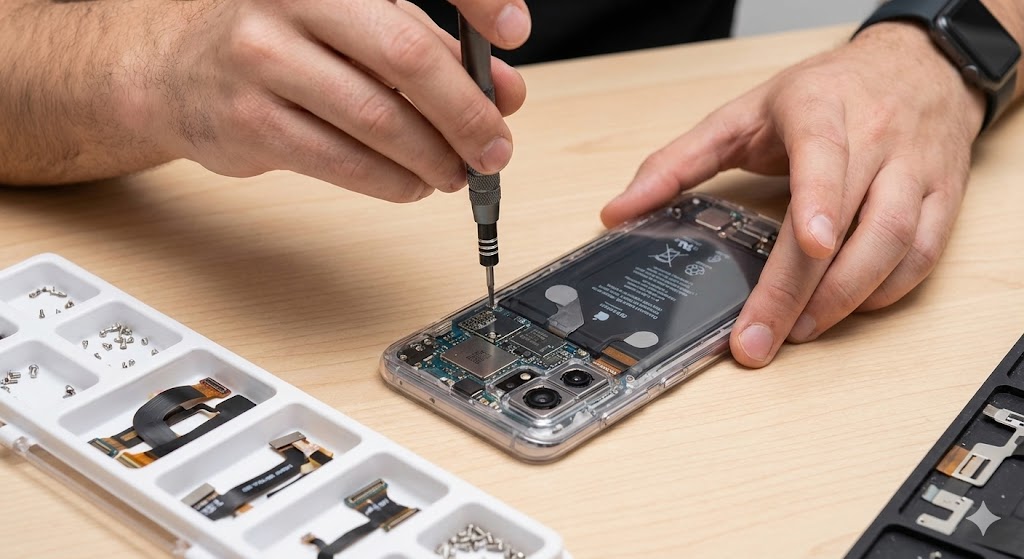
On June 20, 2025, a regulation took effect that fundamentally changed what it means to sell a smartphone in Europe. Every new phone and tablet placed on the EU market must now carry a mandatory energy label that includes, for the first time, a repairability score ranging from A to E. Manufacturers must make 15 types of spare parts available to professional repairers for seven years after a model is discontinued, with delivery within five to ten working days. Five key components — including batteries, displays, and back covers — must also be available directly to consumers. Software updates must be provided for at least five years. (Source: Right to Repair Europe, June 2025)
This is not a voluntary pledge or a marketing initiative. It is a market-access requirement. If a device does not meet these minimums, it cannot legally be sold in the EU.
I work in IT security, where “planned obsolescence” is not just an annoyance — it is a security risk. Every device that gets abandoned by its manufacturer because the battery died or a software update stopped becomes a device running unpatched firmware. The right-to-repair movement has always been partially about sustainability and consumer rights. But for people like me, it is also about keeping the devices people actually use from becoming attack surfaces.
What the Regulation Actually Requires — and Where It Falls Short
The EU Ecodesign regulation for smartphones and tablets is genuinely ambitious. Phones must now survive at least 45 accidental drops without losing functionality. Batteries must retain 80% capacity after 800 charging cycles. The A-to-E repairability label evaluates ease of disassembly, tool requirements, spare part availability, and access to repair information. (Source: Koorvi, December 2025)
But the details reveal compromises that limit the regulation’s real-world impact.
The most significant loophole involves batteries. The original EU Batteries Regulation, adopted in 2023, requires all portable devices sold in the EU to feature user-replaceable batteries by February 2027. However, the Ecodesign regulation for smartphones offers an exemption: if a phone’s battery meets certain longevity thresholds (80% capacity after 1,000 cycles, roughly five years of use), the manufacturer can avoid the user-replaceability requirement entirely. In practice, this means most flagship phones from Apple, Samsung, and Google will likely qualify for the exemption. The sealed phone is not dead — it just needs to prove its battery lasts long enough. (Source: Exponent, November 2025)
Parts pairing is another unresolved issue. This is the practice of software-locking a component — a screen, camera module, or battery — to a specific motherboard. If you replace the screen with an identical but non-authorized part, the phone may display warnings, disable features, or refuse to function normally. Consumer advocacy groups pushed hard for a complete ban on parts pairing. The regulation does not include one. Manufacturers can continue the practice for “security or safety” reasons, which in practice means most will continue doing it. (Source: Secondary Market News, June 2025)
And in a last-minute revision that repair advocates called a significant step backward, the final text no longer requires screens to be user-replaceable with basic tools. Instead, they only need to be replaceable by professionals using commercially available tools — which could still mean expensive equipment in a workshop setting.
The U.S. Is Moving Too, But Differently
The EU gets most of the attention, but the United States has made substantial progress through state-level legislation rather than federal regulation. As of January 2026, more than a quarter of Americans live in states with enforceable right-to-repair laws. California’s Right to Repair Act, Oregon’s landmark legislation that specifically addresses parts pairing, and similar laws in New York, Minnesota, Colorado, and Washington represent real progress. Colorado’s law activates in January 2026, and by fall 2026, that coverage is expected to exceed 35% of the population. (Source: Earth911, January 2026)
A federal bill called the Fair Repair Act, introduced in May 2024, estimates that right-to-repair could reduce household electronics spending by 22%, saving families approximately $330 per year. Whether it passes is another question, but the directional shift in the U.S. is clear: the era of manufacturers treating repair as something to be discouraged is ending, state by state.
What is notable is how the tech industry’s posture has changed. Apple, which fought right-to-repair legislation aggressively for years, expanded its Self Service Repair program to 32 European countries in June 2024 and now supports 65 products. Apple redesigned its battery attachment system using electrically induced adhesive debonding — a technology that makes battery removal dramatically easier without changing the phone’s external design. Samsung and Google have made similar moves. The industry did not embrace repairability voluntarily. It got dragged there by regulation. But it is moving.
Framework, Fairphone, and the Modular Niche
The companies that were already building repairable products before the regulations arrived are in an interesting position. Framework, which makes laptops with user-replaceable components — RAM, storage, battery, screen, keyboard, ports — all swappable without specialized tools — has built a dedicated community. The company publishes CAD files for its laptop chassis, enabling users to 3D-print custom accessories. Fairphone, the Dutch company making modular smartphones with easily swappable batteries, cameras, and screens, released the Fairphone 5 with a commitment to eight years of software support.
These companies prove that repairability and premium build quality are not mutually exclusive. But they also illustrate the market reality: Framework and Fairphone remain niche products. Their combined market share is a rounding error compared to Apple and Samsung. The regulatory push matters precisely because it forces the dominant players to change, not just the idealistic small companies that were already doing the right thing.
What This Means for the Next Five Years
The EU smartphone regulation is a template. Laptops and tablets are expected to receive similar A-to-E repairability labels between 2027 and 2029. The European Commission will review the smartphone regulation itself in 2027, and repair advocates expect future revisions to address spare part pricing caps and potentially restrict parts pairing. A Digital Product Passport registry launching in July 2026 will give consumers access to detailed product lifecycle information. (Source: Medium / Mohamed Abokersh, December 2025)
For consumers, the practical impact will be gradual rather than immediate. You will not wake up tomorrow with a phone whose battery pops out like a 2012 Samsung Galaxy. What you will see is spare parts becoming easier to find, repair manuals becoming publicly available, and a label on the box that tells you — before you buy — how repairable the device actually is.
For manufacturers, the financial implications are more significant than they appear. A device that earns a Class A repairability score and lasts five to six years changes the revenue model fundamentally. Instead of selling a new phone every two years, companies need to build revenue streams around parts, accessories, and service. The smart ones are already pivoting. The ones that are not will find themselves in a market where their products carry a visible D or E grade next to a competitor’s B.
For someone in my field, the most important outcome is software support. The requirement for five years of updates after a model leaves the market means fewer devices running outdated, vulnerable firmware. That is a security improvement that no antivirus app can replicate. The best security patch is a manufacturer that is legally required to keep issuing them.
The right-to-repair movement spent years being dismissed as a fringe concern of hobbyists and environmentalists. In 2025, it became trade law for the world’s second-largest consumer market. That changes things — not overnight, but permanently.
—