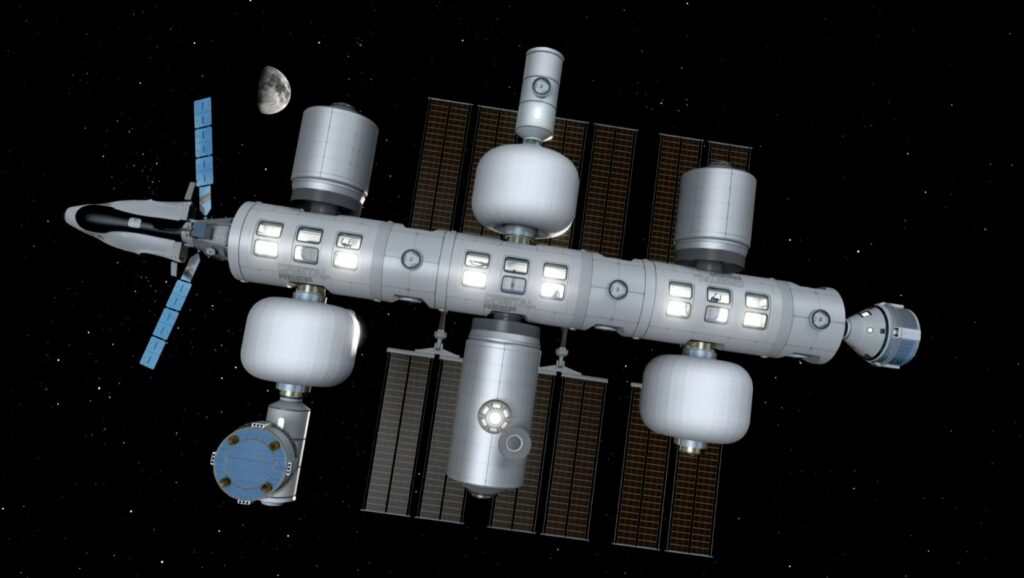
When people hear “space hotel,” they tend to picture something from a science fiction film — rotating rings with artificial gravity, champagne floating in zero-G, panoramic windows overlooking Earth. That image is fun, but it is not what is actually being built right now.
What is being built is more practical, more expensive, and more complicated than any luxury resort. Several companies are in a serious engineering race to construct the first commercial space station in low Earth orbit, driven not by tourism fantasies but by a hard deadline: NASA plans to retire the International Space Station around 2030, and there is currently nothing ready to replace it. The question is no longer whether private companies will operate in orbit. The question is which one gets there first — and whether any of them can make the economics work.
I have been following this space closely because it sits at an intersection I find compelling: advanced engineering, geopolitical competition, and financial risk on a scale that most venture capital firms have never contemplated.
The ISS Is Dying. That Is the Real Story.
The International Space Station has been continuously occupied since November 2000. It is the most expensive single object ever built, with total program costs exceeding $150 billion across all partner nations. It has hosted over 270 crew members from 21 countries and supported thousands of scientific experiments.
It is also falling apart. After more than 25 years in the harsh environment of low Earth orbit — constant thermal cycling, micrometeorite impacts, radiation exposure — the station’s structural integrity is degrading. NASA has officially targeted the end of 2030 for the station’s retirement, at which point a U.S. Deorbit Vehicle will guide it into a controlled re-entry over the South Pacific.
That creates an urgent problem. If there is no commercial replacement ready by 2030, the United States and its partners lose continuous human presence in low Earth orbit for the first time in three decades. China, which operates its own Tiangong space station, would be the only nation with permanent orbital capability.
NASA recognized this risk early. In 2021, the agency launched its Commercial LEO Destinations (CLD) program, awarding initial Space Act Agreements to multiple companies to develop private station designs. Phase 1 distributed approximately $415 million to help companies flesh out their concepts. In 2026, NASA plans to select companies for Phase 2 contracts worth between $1 billion and $1.5 billion, running through 2031. (Source: NASA Commercial Space Stations)
Who Is Actually Building What
There are five major contenders. Their progress levels vary dramatically.
Vast — Haven-1
The current frontrunner in terms of speed is Vast, a California-based startup founded by tech entrepreneur Max Haot. Vast’s strategy is aggressive: build a small, functional station first, prove it works, then scale up.
Haven-1 is a single-module station roughly the size of a shipping container. It can host four crew members for missions lasting up to 10 days, with a planned operational lifetime of three years. The interior design is deliberately different from the ISS — soft surfaces, earth tones, inflatable sleep systems, and a 1.1-meter domed observation window.
In November 2025, Vast successfully launched Haven Demo, a small testbed spacecraft, aboard a SpaceX Bandwagon-4 rideshare mission. The spacecraft achieved mission success, deploying solar arrays and demonstrating critical systems. The Haven-1 primary structure has been built and tested, and the station is currently targeted for launch no earlier than Q1 2027 aboard a SpaceX Falcon 9 — recently delayed from the original May 2026 target. (Source: Payload Space, January 2026)
In February 2026, NASA also awarded Vast a contract for a private astronaut mission to the ISS, launching no earlier than summer 2027. This would make Vast the second company (after Axiom) to send private crews to the station. (Source: The Spokesman-Review, February 2026)
Vast’s longer-term plan is Haven-2, a multi-module station supporting up to 12 crew members, with the first module targeted for 2028 and full station completion by 2032.
Axiom Space — Axiom Station
Axiom takes a fundamentally different approach. Instead of launching a standalone station, Axiom will first attach a module to the ISS itself, then detach it to become a free-flying station when the ISS retires.
The company has already completed four private astronaut missions to the ISS (Ax-1 through Ax-4), with Ax-4 launching in June 2025 and carrying astronauts from India, Poland, and Hungary — each nation’s first government-sponsored human spaceflight. A fifth mission (Ax-5) is planned for no earlier than January 2027.
However, Axiom has faced serious headwinds. The company cycled through three CEOs in just over a year and took a down round in March 2025 that valued it at $2 billion — down from $2.6 billion in 2023. In December 2025, Hungarian firm 4iG committed $100 million in new investment, and in February 2026, Axiom secured an additional $350 million in combined equity and debt financing. Total funding now exceeds $700 million, with $2.2 billion in customer contracts. (Source: GovCon Wire, February 2026)
The company has revised its assembly sequence. Rather than launching four separate modules to the ISS, Axiom now plans to install a Power and Thermal Module (PPTM) first — launching no earlier than 2027 — then undock it to join with Habitat 1 for a free-flying two-module station as early as 2028.
Starlab, Orbital Reef, and the Rest
The field is rounded out by several other competitors. Starlab, a joint venture between Voyager Space and Airbus, recently moved into full-scale development with a target launch of 2028 aboard a SpaceX Starship. Blue Origin’s Orbital Reef program continues development under its NASA Space Act Agreement, with a launch target of 2027 using the company’s New Glenn rocket.
The competitive field is real. NASA will be selecting Phase 2 CLD partners in 2026, and the agency’s funding decisions will significantly shape which of these stations actually gets built. (Source: Singularity Hub, December 2025)
The Economics Problem Nobody Wants to Talk About
Here is the part that most space tourism coverage skips over: none of these stations have a proven business model.
The current price for a seat on a private astronaut mission to the ISS is approximately $55 million per person. Axiom’s four missions to date have operated at a loss. The market for customers willing to pay that amount is extraordinarily thin — a few dozen individuals worldwide, plus a handful of government-sponsored astronauts from nations that do not have their own crewed spaceflight capability.
The companies know this. That is why nearly all of them are pitching their stations as multi-purpose facilities rather than hotels. The revenue streams they are targeting include microgravity research for pharmaceutical companies (protein crystallization, cell growth experiments), in-space manufacturing (fiber optics, specialty alloys), orbital data centers, Earth observation, and government-funded scientific research. Tourism is a revenue line, but not the primary one.
The critical variable is launch cost. SpaceX’s Falcon 9 has already dramatically reduced the price of reaching orbit compared to the Space Shuttle era. Starship, if it achieves routine operations at the costs SpaceX projects, could reduce payload costs by another order of magnitude. That changes the math for station construction, resupply, and crew transport fundamentally.
But Starship is not yet operational for crewed missions. And even at reduced launch costs, building and maintaining a pressurized habitat in the most hostile environment humans have ever occupied remains extraordinarily expensive.
The Realistic Timeline
Based on current progress, here is what actually appears achievable:
By 2027, Vast is likely to have Haven-1 in orbit — a modest but historic milestone as the first standalone commercial space station. The first crewed mission could follow weeks later or up to three years after launch, depending on SpaceX’s safety verification process.
By 2028, Axiom plans to have a free-flying two-module station, and Starlab expects to launch. If any of these timelines hold, the ISS retirement in 2030 could proceed without a gap in orbital capability.
By the early 2030s, we may see multiple commercial stations operating simultaneously, serving different markets. The commercial space industry overall is projected to grow from $630 billion in 2023 to $1.8 trillion by 2035.
As for actual space tourism at prices an average person could afford? That remains a long way off. The “$100,000 space vacation” that gets thrown around in optimistic projections requires launch cost reductions that have not yet been achieved, station capacity that has not yet been built, and a safety record that has not yet been established.
Why This Matters Beyond Tourism
The real significance of commercial space stations is not about vacations. It is about who controls access to low Earth orbit in the post-ISS era.
If the United States succeeds in transitioning to private stations, it establishes a model where orbital infrastructure is commercially operated but government-supported — similar to how airlines operate on government-built airports and air traffic control systems. If it fails, the only permanently crewed station in orbit will be China’s Tiangong, which operates under very different rules about international access and cooperation.
For someone who works in IT security, I also think about the data implications. Several of these station concepts include orbital data centers. Processing sensitive data in space — physically isolated from terrestrial network intrusion — is an idea that defense and intelligence agencies are already exploring through investments from entities like In-Q-Tel.
The race to replace the ISS is not a luxury project. It is infrastructure, strategy, and economics colliding 400 kilometers above our heads. The companies building these stations are not selling dreams. They are trying to solve an engineering problem on a government deadline, with private money, in the most unforgiving construction environment that exists.
Whether they succeed will shape how humanity operates in orbit for the next several decades.
—