In December 2025, Joby Aviation completed its 850th test flight of the year — a 260% increase over 2024. The aircraft had flown in three countries, covered more than 9,000 miles, and completed over 4,900 individual test points. In November, the company began power-on testing of its first FAA-conforming aircraft, entering the final stage of the certification process that determines whether a flying vehicle is safe to carry paying passengers.
That same month, the FAA granted Joby Type Inspection Authorization (TIA), marking the first time any electric vertical takeoff and landing (eVTOL) company had progressed to Stage 4 of the five-stage certification framework. The company is targeting first commercial flights in 2026, initially shuttling passengers between city centers and airports in New York and Los Angeles through partnerships with Delta Air Lines and Blade Air Mobility.
Separately, Archer Aviation’s Midnight aircraft passed its final airworthiness criteria and entered the compliance and flight test phase, though it trails Joby by roughly 6-12 months in the certification timeline. Archer has already secured Part 135 (air carrier), Part 145 (maintenance), and Part 141 (pilot training) certifications, positioning it to launch quickly once aircraft certification is complete.
The question that has followed aviation technology for decades — “where are the flying cars?” — now has a concrete answer. They are in the final months of regulatory testing, and the first commercial routes are being mapped.
—
What These Aircraft Actually Are
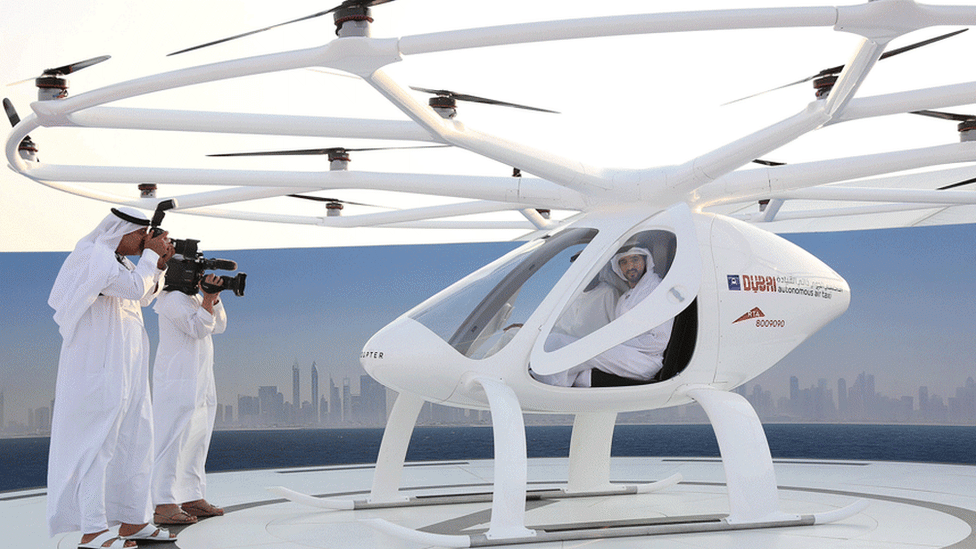
The term “flying car” is misleading. No eVTOL drives on roads. These are electric aircraft with multiple rotors that take off and land vertically — essentially large, quiet passenger drones with wings for efficient forward flight.
Joby’s S4 carries one pilot and four passengers. It uses six tilting rotors powered by electric motors, takes off vertically, then transitions to wing-borne flight at speeds up to 200 mph. The aircraft is designed for trips of 100 miles or less — the precise range needed for city-to-airport shuttles, cross-city hops, and suburban-to-downtown commutes.
The engineering distinction that makes these viable where helicopters failed is threefold. First, distributed electric propulsion — six rotors instead of one main rotor — means no single point of failure. If one motor fails, the aircraft continues flying safely on the remaining five. Second, electric motors are mechanically simpler than turbine engines, with fewer moving parts and lower maintenance costs. Third, and perhaps most commercially important, eVTOLs are dramatically quieter than helicopters. Joby claims its S4 is 100 times quieter than a helicopter during takeoff. From 500 feet away, it produces roughly the noise level of a conversation. This acoustic profile is what makes urban operations politically feasible — residents who would never tolerate helicopter pads next to their homes may accept eVTOL vertiports.
—
The Certification Bottleneck
The reason flying taxis do not yet exist is not physics or engineering — both have been solved at the prototype level for years. The bottleneck is regulatory certification, and for good reason. The FAA must verify that these aircraft are safe enough to carry paying passengers over populated areas, which requires years of testing, documentation, and inspection.
The FAA’s five-stage certification process moves from application acceptance (Stage 1) through design review, testing plans, actual testing, and final certification (Stage 5). Joby has completed approximately 70% of Stage 4, with FAA pilots expected to fly the aircraft for “for-credit” testing in early 2026. Archer’s certification is estimated at 15% complete as of mid-2025, though the company’s operational readiness (with three of four required operating certificates already secured) means it could launch commercially soon after receiving aircraft certification.
The timeline is aggressive but grounded in measurable progress. Industry analysts at SMG had initially forecast Joby’s commercial launch for mid-2026, though updated projections suggest mid-to-late 2027 may be more realistic given the pace of certification flight hours. The key variable is how many issues emerge during TIA testing and how long they take to resolve — a process that cannot be rushed without compromising safety.
—
The Business Model: Not Flying Cars, but Flying Taxis
The commercial model is not selling aircraft to individuals. It is ridesharing between fixed vertiports, similar to how helicopter shuttle services operate today but at a fraction of the noise and cost.
The launch use case is airport connections. A drive from Manhattan to JFK Airport takes 60-90 minutes in traffic. An eVTOL flight would take approximately 7-10 minutes. Dubai is building the first vertiport at Dubai International Airport, expected to be completed in Q1 2026 as part of Joby’s exclusive air taxi service agreement. Similar networks are planned for Los Angeles, New York, and Tokyo.
Initial pricing will likely sit in the $100-$200 range per trip — comparable to an Uber Black or helicopter charter, but at dramatically lower operating costs due to cheaper electric propulsion and lower maintenance requirements. The industry’s long-term target is to reduce per-trip costs to ride-hailing levels ($30-$50) as manufacturing scales and battery costs continue declining.
Joby has hired over 2,000 employees, expanded its production facility in Marina, California to 435,000 square feet, and begun manufacturing carbon fiber propeller blades at a new facility in Dayton, Ohio — infrastructure designed for production of up to 500 aircraft per year. The company’s financial position includes $991 million in cash reserves and a $250 million investment from Toyota.
—
What Could Delay This
The risks are real and specific. Battery energy density limits current eVTOLs to trips under 100 miles — a constraint that restricts the addressable market to urban and suburban routes. Weather limitations (wind, ice, low visibility) could reduce operational reliability in some markets. And community resistance to vertiport placement — despite the noise advantages over helicopters — could slow infrastructure deployment in dense urban areas.
The competitive field also includes risk. Lilium declared insolvency in November 2024 after failing to secure timely European certification. Eve Air Mobility (backed by Embraer) pushed its commercial launch from 2026 to 2028. The history of aviation startups is littered with companies that solved the engineering but failed to survive the certification timeline.
For consumers, the practical question is simple: will an eVTOL be available to book in 2026? Probably not in the United States, where certification is likely to extend into 2027. In Dubai, where Joby has exclusive operating rights and regulatory processes move faster, commercial flights could begin late 2026. In all markets, the transition from first flight to routine service will take years, not months.
The flying taxi is no longer a concept. It is a specific aircraft, with a specific certification timeline, operated by specific companies with specific financial backing. Whether it arrives in 2026 or 2028, the era of electric urban aviation has moved from engineering speculation to regulatory paperwork — and the paperwork is in its final stages.
—
Sources:
1. Joby Aviation — Year-End 2025 Flight Testing Recap (December 2025) 2. FLYING Magazine — Why Joby Thinks Passenger Air Taxi Service Will Lift Off in 2026 (December 2025) 3. PrivateCharterX — eVTOL Certification 2025: FAA Timeline for Joby & Archer (December 2025) 4. ePlane AI — Joby Aviation Leads Archer in Electric Air Taxi Development (August 2025) 5. CompositesWorld — Joby eVTOL Moves Toward Final Stages of Certification (November 2025) 6. Autonomy Global — What to Expect in 2026 for Advanced Air Mobility (December 2025) 7. Commercial UAV News — The Diverging Paths to FAA Certification: Joby, Archer, and Electra (January 2026)
Disclaimer: This article discusses aviation technology developments for informational purposes. It does not constitute investment advice. Joby Aviation (NYSE: JOBY) and Archer Aviation (NYSE: ACHR) are publicly traded companies. Past progress does not guarantee future timelines or commercial success.